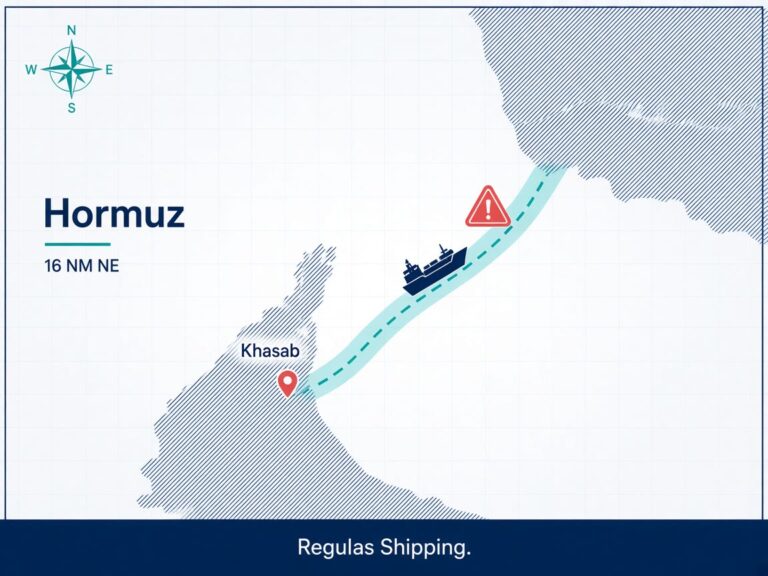
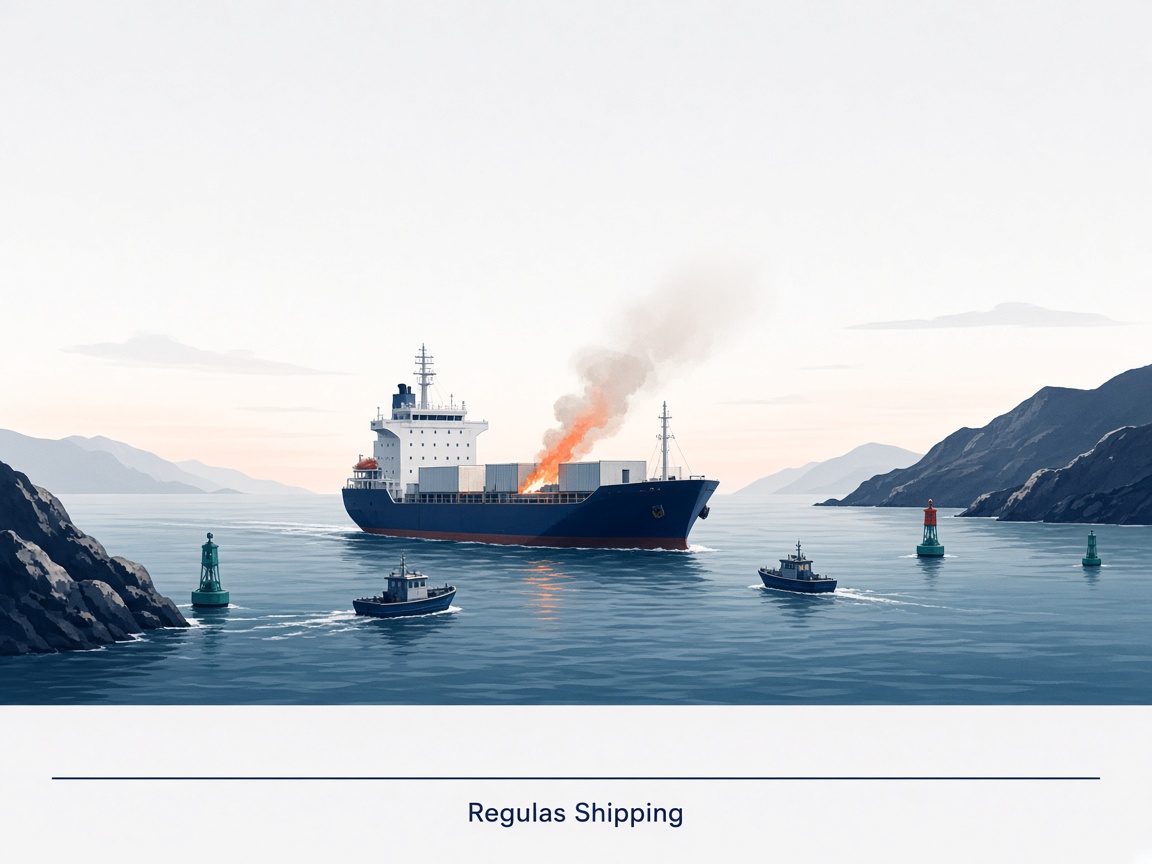
UK Maritime Trade Operations issued Warning 134-26 Update 001 on Sunday, 13 September 2026, after a fire broke out on the unnamed commercial vessel that had been struck by an unknown projectile while transiting the Strait of Hormuz. The original warning, received at about 2300 UTC on Saturday, 12 September, had said the crew’s condition, the damage and any environmental impact were unknown. The Sunday update said local authorities were on scene and assisting in evacuating the crew. The extent of the fire, the condition of the hull and any pollution remained unknown. UKMTO again told traffic in the area to exercise caution and to report suspicious activity.
Separately, Iranian authorities reported a merchant vessel struck around 0500 local time (0130 UTC) on Sunday off Hengam Island and the Shib Deraz coast of Qeshm, the largest island in the strait. Qeshm governor Hossein Amirteimouri, also rendered Amir Teymouri in some English-language reports, said one person was killed and three others were injured; Tasnim quoted the same official as saying one dead and four injured after a projectile hit a commercial container ship. Iranian state media described the strike as a U.S. attack. The governor, speaking to IRNA, blamed a “terrorist enemy” and, to Tasnim, the “American-Zionist enemy.” Washington had not commented on the Iranian report by Sunday morning. Anadolu treated the UKMTO fire-and-evacuation product and the Qeshm fatality as two files. Operators should do the same until a ship name, IMO number or a matching UKMTO identification closes the gap.
The Saturday-night warning and the Sunday-morning Iranian report sit a few hours apart on the same water. Warning 134-26 was received at 2300 UTC, which is 0230 Sunday in Iran (UTC+3:30). The Qeshm strike is timed at 0500 local, 0130 UTC. Those clocks do not prove a single hull and they do not prove two. They do prove that the strait produced a projectile, a fire, an evacuation and a seafarer death inside one overnight watch. Several explosions were also reported overnight around Qeshm. Company security officers who fold the Iranian fatality into the unnamed UKMTO product, or who treat Update 001 as a routine damage line on this morning’s warning, will brief the next inbound as if the night produced one incomplete report. It produced a live fire, a crew leaving the ship, and at least one dead seafarer on an Iranian commercial hull.
The numbered sequence around those two pictures has not paused. Warning 133-26, at 1910 UTC on Thursday, 10 September, logged four unknown projectiles on two unidentified vessels about 4 nautical miles west of Khasab, with one hull on fire. Advisory 129-26 covered disabling fire on merchant ships in the northern Gulf and the Gulf of Oman. Warning 130-26 covered the Gibraltar-flagged products tanker Hercules Star (IMO 9916135) off Port Rashid, where Peninsula confirmed one seafarer killed and one missing. The International Maritime Organization’s incident list, updated on 8 September, already recorded 73 confirmed vessel attacks since late February, with 21 seafarer deaths. A Sunday fire that forces an evacuation, and a Sunday morning fatality off Hengam, sit on top of that file. They do not start a new one.
The traffic that would have to steam through that overnight envelope is still thin. Preliminary Kpler counts earlier in the week put Hormuz commodity transits at nine on Wednesday, two on Thursday and 14 on Friday — 10 exiting the Gulf and four entering — against a pre-crisis baseline of around 100 crossings a day. Reuters data for a ten-day stretch in early September averaged about 10 commodity ships a day, the lowest since May. U.S. Central Command has said 96 commercial vessels were redirected away from the strait as of 10 September. Kpler had counted more than 500 commercial hulls stuck inside the Arabian Gulf in the same week. Most ships that did move went dark. A fire that requires local authorities to take the crew off an unnamed hull is therefore not a sideshow in a busy lane. It is the night’s main event in a single-digit or low-teens transit market, and it arrives a day before Iran and Oman are due to brief Gulf foreign ministers on new entry and exit routes.
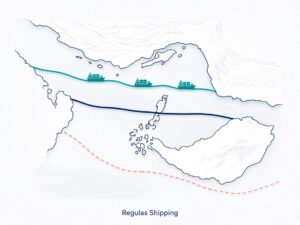
Monday’s Oman meeting does not change Sunday’s damage-control picture. Iranian officials said they would present new Hormuz routes to regional ministers on 14 September, with the inbound lane drawn entirely in Iranian territorial waters and the southern route to close once the new system operated. Tehran has also said a paper corridor is not a reopening while a U.S. naval blockade remains in force. A master still holding for a Monday “safe lane” is holding in the same water that just produced a fire, an evacuation and a fatality. The diplomatic product can be read on Tuesday. The fire has to be fought on Sunday.
The operational implication is that an unnamed UKMTO hit can now mature into a fire-and-abandonment event before the ship is identified, and that an Iranian-flagged commercial hull inside Iranian waters is not outside the projectile envelope. If Warning 134-26 is your ship, flag, P&I, war-risk and a named company officer who owns next-of-kin have to start from Update 001 — fire, local authorities, crew leaving the vessel — not from Saturday night’s “status unknown” line. If the Qeshm hull is yours, the clock starts from the governor’s casualty figures, not from a later U.S. comment that may never come. Passage plans for any remaining Hormuz, Musandam, Qeshm, Hengam, Fujairah or Gulf of Oman movement should assume a projectile can arrive after dark, that a fire can follow, and that the first useful sentence from the bridge is a voice report to UKMTO while people are still on board.
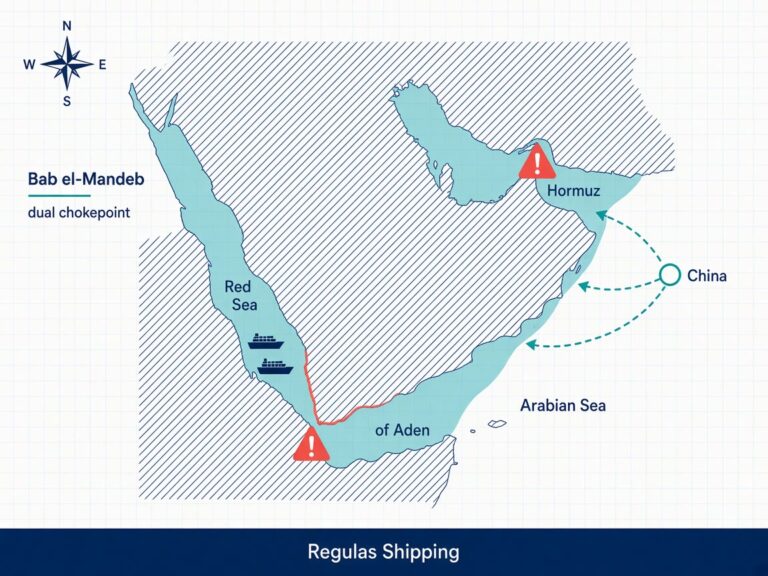
Damage-control and evacuation readiness belong on the pre-arrival checklist for the strait the same way they do for a declared high-risk area. Update 001 is a firefighting and abandonment event, not only a security warning. Make sure the fire party, fixed systems, breathing apparatus and the decision point for leaving the ship are briefed before the last miles of the TSS, not after smoke is in the accommodation. A dark AIS picture complicates the search if the next unknown crew-status line is your hull. Write the company’s AIS rule for the last miles of the strait, including when a shuttle or waiting order is in force. Masters should report to UKMTO while the incident is live, register with the Maritime Security Centre — Indian Ocean under Best Management Practices for Maritime Security, and file with the Information Fusion Centre — Indian Ocean Region when operating in the Gulf, the Gulf of Oman or the Arabian Sea.
What Operators Should Note
- Treat Update 001 as a new product, not a footnote on this morning’s warning. Warning 134-26 at 2300 UTC on 12 September said crew, damage and pollution were unknown. The Sunday update said a fire had broken out and local authorities were evacuating the crew. That is a firefighting and abandonment event on an unnamed commercial hull in the lane.
- Keep the Qeshm fatality in a separate file until a name matches. Qeshm’s governor timed a merchant or container vessel strike at about 0500 local (0130 UTC) off Hengam and Shib Deraz, with one dead and three or four injured. Iranian state media blamed the United States. The U.S. had not confirmed. Anadolu logged the two reports separately. Do not brief them as one ship.
- Do not wait for a vessel name before starting the casualty clock. UKMTO may never identify Saturday night’s ship. If it is yours, flag, P&I, family and a named company officer have to work from the fire-and-evacuation line. If the Iranian hull is yours, work from the governor’s numbers. IBIA’s 10 September statement still stands: seafarers are civilians and the ship is not a party to the war.
- Put fire and abandonment on the Hormuz pre-arrival checklist. A projectile warning can become a fire before the next watch. Brief the fire party, fixed systems and the master’s decision point for leaving the ship before the last miles of the strait, not after smoke is reported.
- Do not brief Monday’s Oman meeting as a reason to hold in the box. New entry and exit routes are a diplomatic product for 14 September. They do not cancel a Sunday fire, an evacuation or a seafarer death. A ship still west of Musandam is still inside the envelope that produced both reports.
- Keep BMP MS, UKMTO, MSCIO and IFC-IOR live, including when the ship is stopped, dark or waiting as a shuttle hull. Report while the incident is happening. Re-open war-risk and waiting language for Qeshm, Hengam, Khasab, Fujairah and Gulf of Oman holds. Name who authorises remaining in the strait after a numbered warning has already matured into a fire.
Regulas Shipping will keep lining UKMTO Hormuz updates against Iranian casualty reports so operators can treat a Sunday fire, an evacuation and a named fatality as security decisions, not as one incomplete overnight line to wait out.