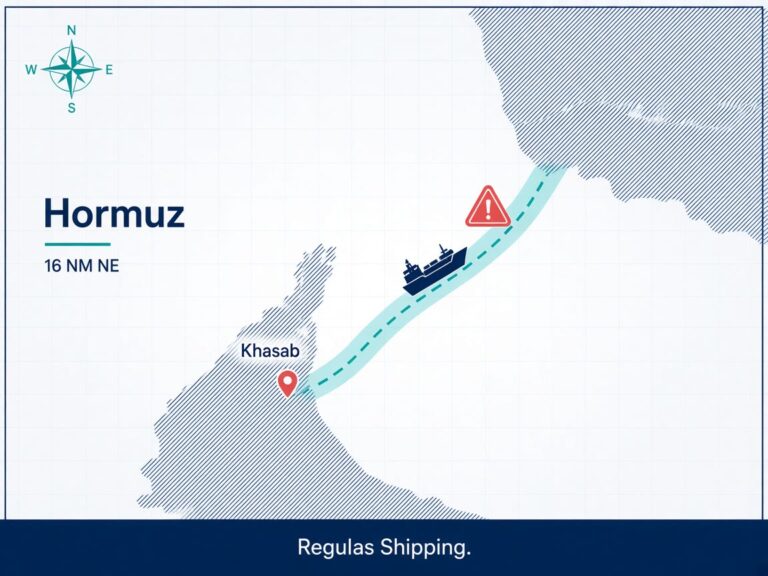
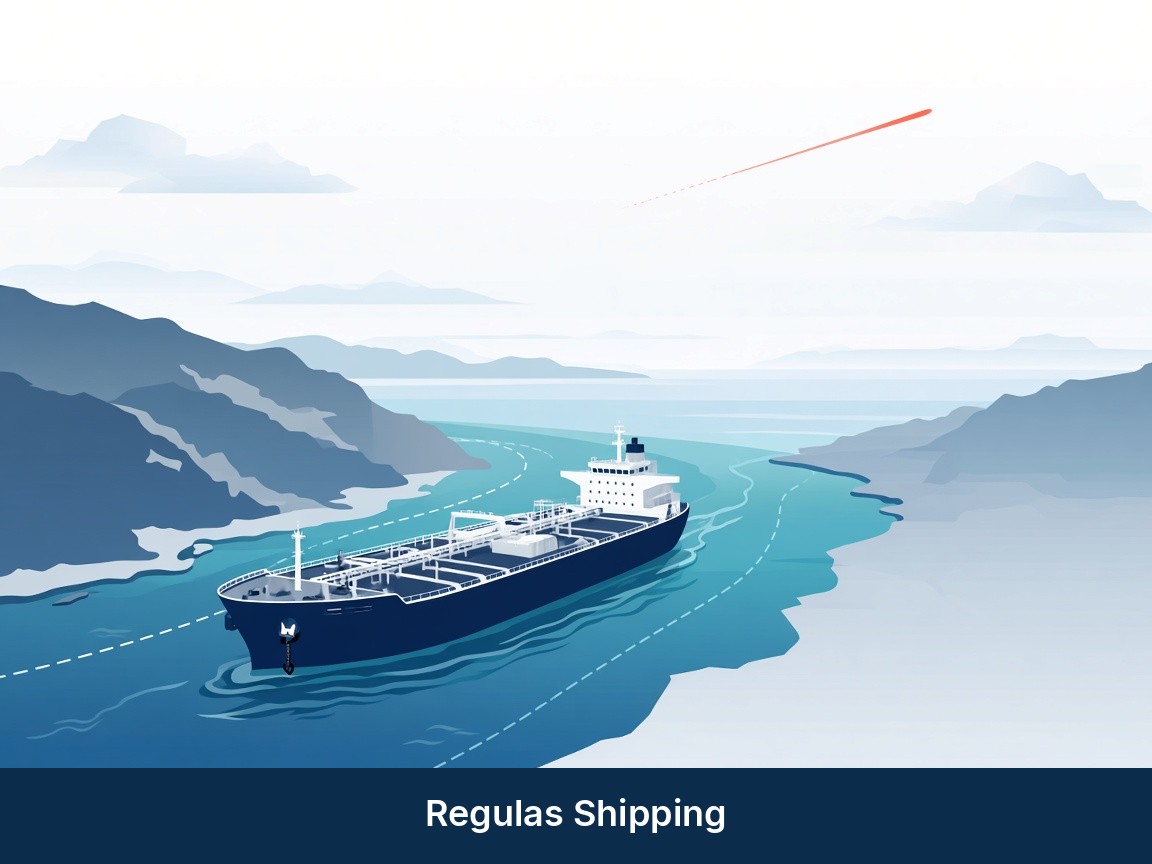
The United Kingdom Maritime Trade Operations centre issued Warning 134-26 early on Sunday, 13 September 2026, after a commercial vessel was struck by an unknown projectile while transiting the Strait of Hormuz at about 2300 UTC on Saturday, 12 September. UKMTO did not name the ship, the flag, the operator or the cargo. It did not say whether the weapon was a missile, a drone, a rocket or another projectile. At the time of the warning the crew’s condition, the damage assessment and any environmental impact were all unknown. Authorities opened an investigation. Traffic in the area was told to proceed with heightened caution and to report suspicious activity.
Warning 134-26 is the next numbered product after Warning 133-26, which at 1910 UTC on Thursday, 10 September, logged four unknown projectiles on two unidentified vessels about 4 nautical miles west of Khasab, Oman, with one hull on fire. That report came from a third master 6 nautical miles south of the contacts. Between those two warnings sit Advisory 129-26, which said several merchant ships in the northern Gulf and the Gulf of Oman had been subjected to “disabling fire,” and Warning 130-26 on the Gibraltar-flagged products tanker Hercules Star (IMO 9916135) off Port Rashid, where Peninsula confirmed one seafarer killed and one missing. The Saturday-night hit is therefore not an isolated splash. It is the latest unnamed hull in a ten-day sequence that has already reached Dubai anchorage, Al Faw and the Musandam gateway.
The traffic picture around the warning is thin enough that a single projectile changes the night’s risk for every ship still in the lane. Preliminary Kpler counts earlier in the week put Hormuz commodity transits at nine on Wednesday, then two on Thursday, before a rebound to 14 on Friday — 10 exiting the Gulf and four entering — against a pre-crisis baseline of around 100 crossings a day and more than 20 million barrels of oil. Most ships that did move went dark. U.S. Central Command has said 96 commercial vessels were redirected away from the strait as of 10 September under a blockade posture that Washington dates to mid-July. Kpler had counted more than 500 commercial hulls stuck inside the Arabian Gulf in the same week. The International Maritime Organization’s incident list, updated on 8 September, already recorded 73 confirmed vessel attacks since the conflict opened in late February, with 21 seafarer deaths. A projectile at 2300 UTC, with no name and no damage line, sits on top of that file rather than starting a new one.
Attribution is not available and should not be invented on the bridge. Iran’s Islamic Revolutionary Guard Corps claimed earlier in the week that it had fired on two U.S. vessels and eight oil tankers attempting to cross a prohibited area of the strait, and that it had struck a U.S. Saildrone Explorer unmanned surface vessel, hull 5838, at the Hormuz entrance on 10 September. The United States did not confirm the Saildrone claim. Washington has described a tanker-for-tanker response after accusing the IRGC of ballistic-missile attempts against a U.S. Navy warship. None of that identifies Saturday night’s projectile. UKMTO’s language is the operational fact: unknown weapon, unnamed commercial ship, unknown crew status, investigation open. Company security officers who wait for an IRGC telegram, a CENTCOM confirmation or a vessel name before treating Warning 134-26 as a live strike will brief the next inbound too late.
The diplomatic calendar does not suspend the projectile envelope. Iranian officials said Iran and Oman had agreed details of new entry and exit routes for the strait and would brief Gulf foreign ministers at a meeting in Muscat on Monday, 14 September. A source close to Iran’s negotiating team, reported by Tasnim, said the Gulf entry route would lie entirely in Iranian territorial waters, that part of the exit would also fall inside Iranian waters, and that the southern route would close once the new system operated. Tehran has been clear that a paper route is not a safety guarantee while a U.S. naval blockade remains in force. Operators who have been using the Omani southern highway — the same Musandam corridor that took the 31 August projectile east of Khasab and the 10 September dual-hull strike west of it — should not read Monday’s briefing as a reason to thin the watch on Saturday night’s water. A route drawn in Iranian waters is a political product. A projectile at 2300 UTC is a ship-security event.
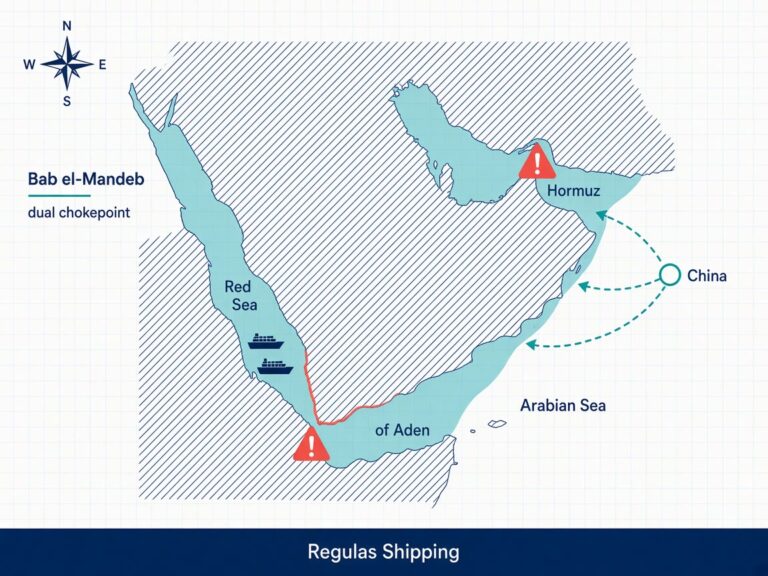
The workaround picture has also tightened. Saudi Arabia’s Ministry of Energy said on 11 September that the East-West crude pipeline, Petroline, had been stopped as a precaution after drones of Iraqi origin. That line is the principal Hormuz bypass to Yanbu on the Red Sea. With Hormuz already a single-digit or low-teens transit market and the Yanbu outlet offline, remaining Gulf cargo has fewer honest exits. Houthi forces seized Mokha on 10 September and reached Perim at the Bab el-Mandeb, and Kpler had Bab el-Mandeb crossings down to 15 on Friday from 30 the previous day. A master still holding in the Gulf of Oman or hugging Musandam is not choosing between a “safe” southern lane and a closed Iranian lane. He is choosing which warning number is most likely to arrive while the ship is in the box.
The operational implication is that an unnamed hit is now the normal form of a Hormuz report, not an incomplete one. Warning 133-26 named neither ship. Warning 134-26 names neither ship. If the Saturday-night hull is yours, flag, P&I, war-risk and a named company officer who owns next-of-kin have to start the clock from the UKMTO product, not from a later press identification that may never come. Passage plans for any remaining Hormuz, Musandam, Fujairah or Gulf of Oman movement should assume a projectile can arrive after dark, that AIS may already be off, and that the first useful sentence from the bridge is a voice report to UKMTO while the event is happening. Damage-control, citadel and firefighting readiness belong on the pre-arrival checklist for the strait the same way they do for a declared high-risk area. Insurers will ask whether the ship was in a declared area, whether lookouts and the Ship Security Plan matched the threat, and whether the voyage order still treated a Monday Oman meeting as a reason to proceed.
Reporting and welfare have to sit in the SMS before the next numbered warning. Masters should report to UKMTO while the incident is live, register with the Maritime Security Centre — Indian Ocean under Best Management Practices for Maritime Security, and file with the Information Fusion Centre — Indian Ocean Region when operating in the Gulf, the Gulf of Oman or the Arabian Sea. A dark AIS picture does not remove the ship from a projectile envelope, and it complicates search and rescue if the next unknown crew-status line is your hull. Write the company’s AIS rule for the last miles of the strait, including when a shuttle or waiting order is in force. Silence in the voyage order on remaining west of Khasab, holding as a shuttle hull, or proceeding dark through the southern highway will land on the owner. UKMTO’s own language is the line to put in the bridge pack: heightened caution, report suspicious activity, and do not wait for vessel names that may never be published.
What Operators Should Note
- Put Warning 134-26 in the bridge pack for any remaining Hormuz or Musandam transit. Unknown projectile, unnamed commercial vessel, about 2300 UTC on 12 September, crew status, damage and pollution unknown. Treat it as a live overnight strike in the lane, not as an unconfirmed rumour to wait out until Monday’s talks.
- Read 134-26 as the next product in one theatre, not a new file. Warning 133-26 (Khasab, 10 September), Advisory 129-26 (disabling fire), Warning 130-26 (Hercules Star) and the 10 September Saildrone claim sit on the same water. The Saturday-night hit does not reset the threat assessment.
- Do not brief Monday’s Oman meeting as a safety clearance. Iran and Oman say they will present new entry and exit routes in Muscat on 14 September, with the southern route to close under an Iranian-water design. That is a diplomatic product. It does not cancel a projectile that already arrived at 2300 UTC.
- Stop treating the Omani southern highway as the low-threat lane. Khasab has now taken projectiles east of the port (31 August) and west of it (10 September). A ship that hugs Musandam to avoid the Iranian side is still inside the envelope that produced Warning 134-26.
- Write the unnamed-casualty procedure before the next warning. UKMTO may never identify Saturday night’s ship. If it is yours, flag, P&I, family and a named company officer have to know the clock without a press line. IBIA’s 10 September statement still stands: seafarers are civilians and the ship is not a party to the war.
- Keep AIS policy honest against the dark-transit pattern. Most Hormuz movers this week switched transponders off. A dark picture does not remove the ship from a projectile envelope, and it complicates SAR. Write the company’s AIS rule for the last miles of the strait, including shuttle and waiting orders.
- Keep BMP MS, UKMTO, MSCIO and IFC-IOR live, including when the ship is stopped or dark. Report while the incident is happening. Re-open war-risk and waiting language for Khasab, Fujairah and Gulf of Oman holds. Name who authorises remaining as a shuttle hull after a numbered UKMTO warning in the same sector.
Regulas Shipping will keep lining UKMTO Hormuz projectile warnings against the southern-highway, shuttle and Oman-talks calendar so operators can treat an unnamed overnight hit as a security decision, not as a gap in the record to wait out.