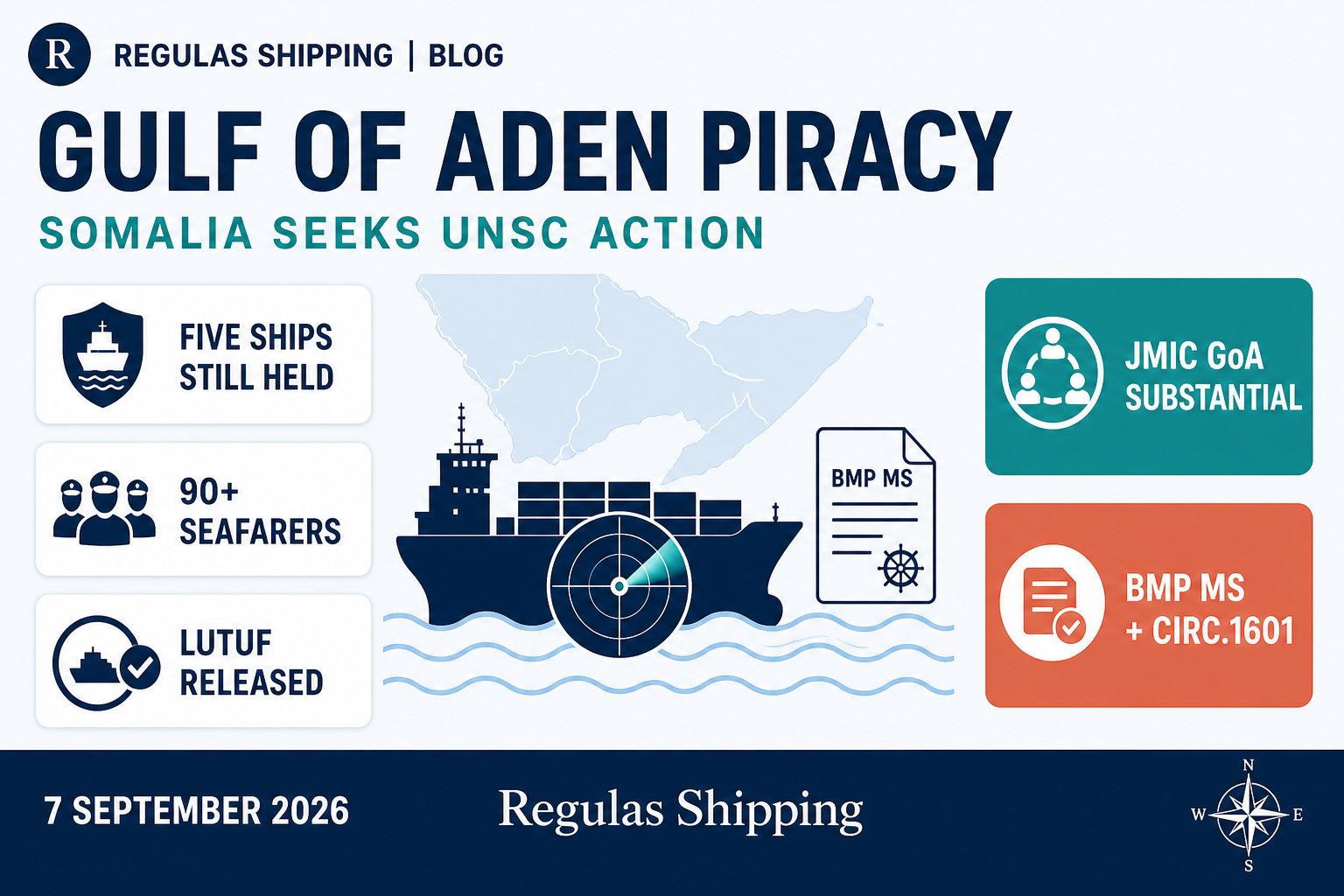
On 6 September 2026 Somalia’s foreign ministry called for coordinated international action against a renewed piracy wave off Puntland and into the Gulf of Aden, saying it would take the threat to the UN Security Council. The immediate operator fact is simpler than the diplomacy: five merchant ships remain in pirate hands after the late-August release of MV Lutuf, and the International Maritime Organization (IMO) had already counted more than 90 seafarers held after the 20 August hijacking of the tanker Seamull (also reported as Sibu 1).
The ministry’s Sunday statement said attacks and seizures have targeted commercial vessels since April and demanded the “immediate and unconditional release” of all seafarers still being held. “Somalia will not permit its waters to become a haven for maritime crime,” it said. Mogadishu is using its two-year Security Council seat, which runs through the end of 2026, and pointed to Article 100 of UNCLOS — the duty of states to cooperate in repressing piracy — plus the Djibouti Code of Conduct and its 2017 Jeddah Amendment.
The seizure list is no longer a handful of coastal feeders. IMO identified six vessels after Seamull was taken: Honour 25 (21 April), Sward (26 April), Eureka (2 May), Asana (17 July), Lutuf (17 August) and Seamull (20 August). Lutuf, a Cameroon-flagged general cargo ship (IMO 9109134, about 1,401 dwt), was boarded by eight armed men roughly four nautical miles off Mareeyo in Puntland’s Eyl district and taken toward the Nugaal coast. Somalia’s defence ministry said Turkish naval forces and the Somali National Armed Forces then ran a 10-day operation that destroyed four pirate boats and left 14 alleged pirates dead, after which Lutuf “safely resumed its voyage.” Puntland’s security ministry disputed that account, saying there was no federal or Turkish rescue and alleging a ransom — figures around US$2.5 million have circulated without independent confirmation. Operators should treat the release as confirmed and the method as contested.
Seamull’s boarding is the clearer deep-water warning. UKMTO reported six armed men taking the tanker about 136–155 nautical miles east of Al Mukalla, Yemen, on 20 August, after which the ship altered course toward Somalia. Reporting has linked the ship to the US-sanctioned “shadow fleet” used to move Iranian oil. IMO Secretary-General Arsenio Dominguez said a sixth vessel in pirate hands left “waters that are becoming too dangerous for seafarers,” with captives often short of food, fresh water and medical support. Pakistan said late last month that pirates still held 10 of its nationals aboard Honour 25. The Joint Maritime Information Center (JMIC) has rated piracy on the Somali coast/Somali Basin as moderate and the Gulf of Aden overall as substantial, because piracy now sits on top of residual Houthi risk.
What has changed operationally is reach, not just count. Sward, itself seized in April, was used as a mothership in the Lutuf boarding. Groups are working in the southwest monsoon, when small-boat range is normally limited, and they have already gone well offshore into Yemeni waters — Eureka was taken off an eastern Yemen oil terminal in May. EL PAÍS, citing IMO figures, noted that first-half 2026 piracy and armed robbery worldwide fell to 38 incidents, the lowest since 1992, but Somali groups accounted for 94 percent of hijackings. Naval capacity that used to sit on the Horn of Africa patrol pattern has been pulled toward the Red Sea and the Strait of Hormuz. Traffic that cannot use Hormuz or prefers to avoid the southern Red Sea is also denser along the Somali seaboard. Analysts expect conditions to ease after the monsoon, which is why several briefings flag October onward as the higher-activity window, not a quieter one.
Industry removed the Indian Ocean High Risk Area designation from January 2023 after a decade of suppression. That administrative change did not repeal BMP. Dominguez has told flag and coastal states to apply BMP Maritime Security — the April 2025 consolidated guidance that replaced Global BMP, BMP5 and BMP West Africa — and IMO circular MSC.1/Circ.1601/Rev.2. EU NAVFOR’s Operation Atalanta was already tracking unresolved cases off northern Somalia by July, when IMO counted 24 attempted or actual incidents in the Red Sea and Gulf of Aden over the prior three months and 44 seafarers held on Honour 25, Eureka and Sward. Those numbers have since gone up, not down, even with Lutuf free.
For commercial teams the read-through is voyage-specific, not a blanket “avoid the Horn.” Gulf of Aden, Somali Basin and western Indian Ocean passages need a current company threat assessment, citadel and citadel-drill status, AIS and reporting discipline to UKMTO/MSCHOA, and a clear armed-guard or vessel-protection decision that matches flag, coastal-state and insurer conditions. Charter-party war-risk, piracy and deviation clauses written against a 2023–24 “piracy contained” assumption are stale. So are routing notes that treat the monsoon as a seasonal stand-down. Crew welfare is not a side issue: families of the remaining hostages still have little reliable information, and a second winter of detention on Honour 25 and Sward would be a manning, P&I and reputational problem as well as a security one.
What Operators Should Note
- Treat five ships as still held. Honour 25, Sward, Eureka, Asana and Seamull/Sibu 1 remain the working list after Lutuf’s release. Confirm positions and crew nationalities with the flag state, UKMTO and the company before any Horn of Africa voyage briefing.
- Do not read the monsoon as cover. August boardings happened in southwest-monsoon conditions, including Seamull more than 130 nm off Yemen. Plan for a further rise from October as sea states ease, not a seasonal pause.
- Assume mothership tactics. Sward’s use against Lutuf means a captured merchant ship can extend pirate reach. Watch AIS for loitering, dark or erratically routing merchant hulls on the Somali coast, not only skiffs.
- Re-apply BMP Maritime Security and MSC.1/Circ.1601/Rev.2. The 2023 Indian Ocean HRA removal is not a BMP stand-down. Citadels, lookouts, hardening, drills and company reporting to UKMTO/MSCHOA should be voyage-specific and recorded in the SSP.
- Price Gulf of Aden as a stacked risk. JMIC’s “substantial” GoA rating combines piracy with Houthi exposure. War-risk, K&R, additional premiums and armed-guard rules of engagement need a single file, not two disconnected quotes.
- Keep crew-protection and K&R live. More than 90 seafarers were in captivity after Seamull; Pakistan has 10 nationals still on Honour 25. Manning, next-of-kin protocols and P&I notification should be tested before the next scheduled GoA transit.
- Watch Mogadishu–Puntland friction on incident response. Lutuf’s release method is disputed. Do not assume a single coastal-state rescue channel; coordinate through flag, UKMTO and the company security officer, and log any contact with local forces.
Regulas Shipping will keep lining IMO, JMIC and UKMTO piracy notices against BMP Maritime Security so operators can see which Horn of Africa controls are still required while five ships and their crews remain in pirate hands.