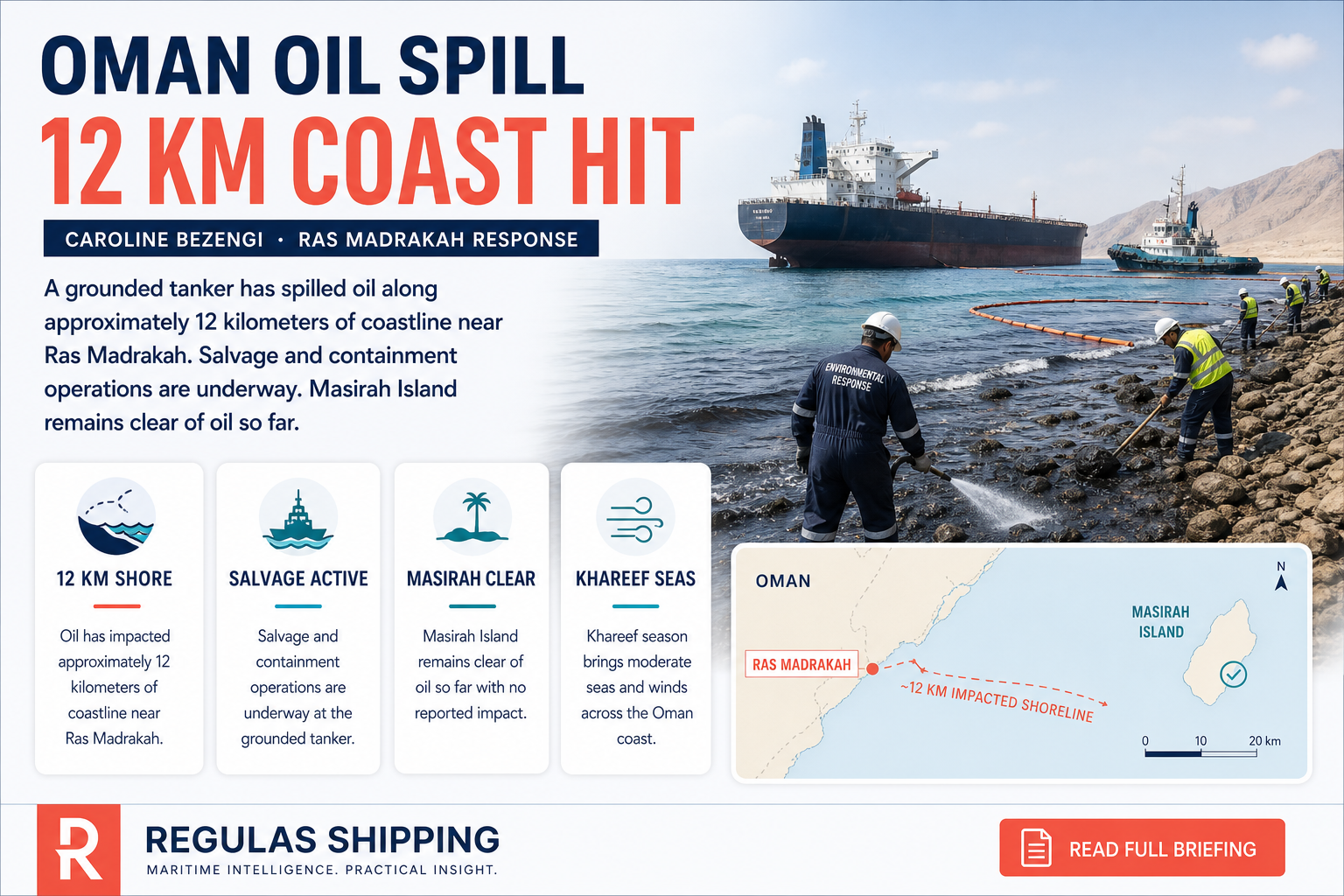
Oman’s Environment Authority reports that roughly 12 kilometres of coastline at Ras Madrakah has been affected by oil pollution linked to the grounded tanker Caroline Bezengi, while salvage and shoreline response continue under difficult khareef-season weather. Authorities say no significant pollution has been confirmed on Masirah Island so far, though monitoring and contingency equipment remain in place.
The tanker grounded off Al Qibliya / Al Hallaniyat waters after a suspected explosion reported in early June while en route from Russia toward India. Cargo estimates have been put above 800,000 barrels. Satellite tracking showed the slick expanding across hundreds of square kilometres before oil reached the Duqm–Ras Madrakah coast. UK risk firm Ambrey said specialist teams boarded with Royal Air Force of Oman support to stabilise the vessel and cargo, deploying salvage craft, aircraft and more than 100 tonnes of equipment.
Safety and Environmental Exposure
Rough monsoon seas are slowing access and stability work, raising the risk of further leakage if the half-submerged hull deteriorates. Coastal fishing communities have been advised to exercise caution. Water-quality sampling in Ras Madrakah and Al Duqm has been reported within standards so far, with contingency plans for coastal wells if desalination intakes are threatened.
For operators, the incident is a live reminder that shadow-fleet and conflict-adjacent tonnage casualties can create multi-week pollution and salvage emergencies even outside active chokepoint combat zones.
What Operators Should Note
- Avoid the salvage exclusion zone and heed Oman Coast Guard / NCEM notices around Al Hallaniyat and Ras Madrakah.
- Update SOPEP and coastal-state notification drills for monsoon-season grounding scenarios.
- Charterers moving Gulf of Oman tonnage should factor pollution-response delays into schedules.
- Scrutinise ageing or opaque-ownership tankers for casualty and spill liability exposure.
RegulAs Shipping will follow salvage progress and any expansion of shoreline impact beyond the current 12 km zone.