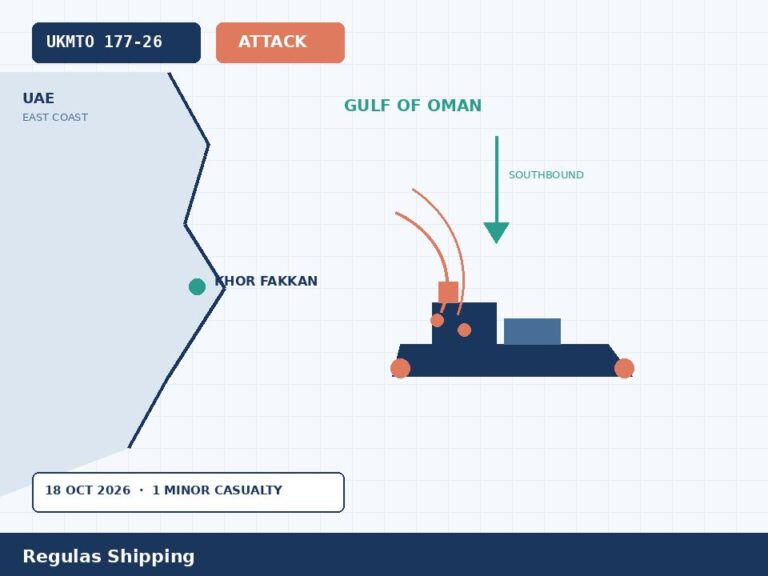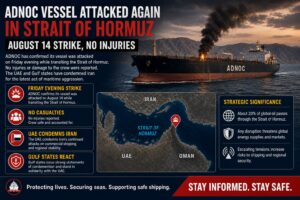
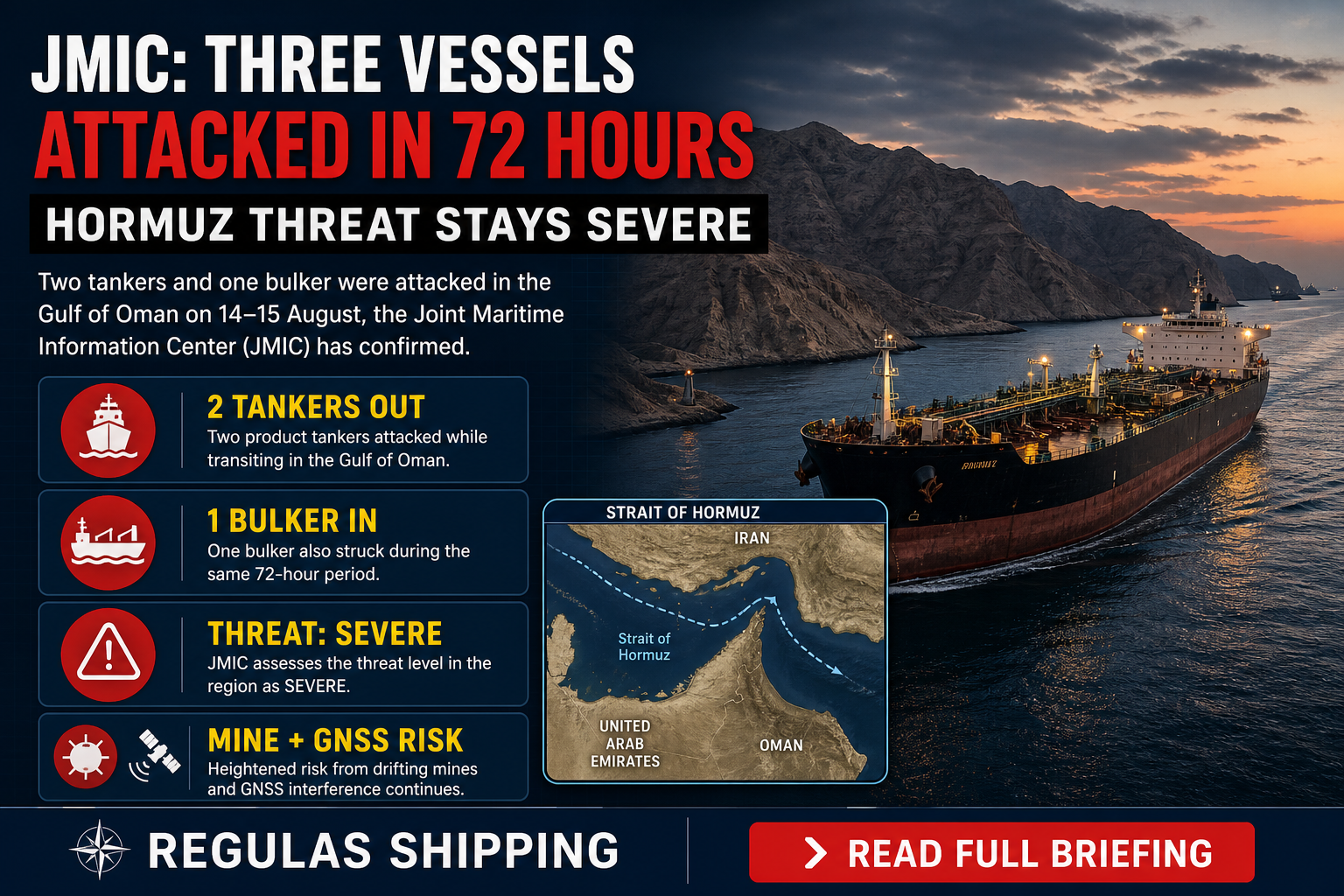
The Joint Maritime Information Center (JMIC) says three commercial vessels were attacked in the Strait of Hormuz over a 72-hour window spanning 14–15 August, while the center maintained a Severe threat assessment for the chokepoint. The strikes involved two tankers and a bulk carrier and came as commercial traffic through Hormuz remained far below normal.
On 14 August, two tankers were hit by unknown projectiles while travelling outbound. Both suffered minor damage, continued under their own power, and reported no crew injuries or environmental impact. On 15 August, an inbound bulk carrier was struck on the hull by an unknown projectile; no casualties were reported, though the full extent of damage and any pollution risk remained unclear in the initial assessment.
Traffic Still a Fraction of Normal
JMIC counted 57 U.S.-facilitated Strait of Hormuz transits between 13 and 15 August against a historical daily average near 138. Tracking data showed single-digit tanker movements — or none — in either direction on some days. The center said the latest attacks are consistent with Iran’s assessed intent and capability and do not change the Severe rating.
Vessels broadcasting AIS may still receive radio calls directing them onto the northern Iranian-controlled route. JMIC also warned of drifting or uncharted mines around the traffic separation scheme and persistent GNSS interference across Hormuz, the Gulf of Oman and the wider Arabian Gulf.
What Operators Should Note
- Treat outbound and inbound Hormuz legs as equally exposed after strikes on both directions in 72 hours.
- Engine-room and hull hits remain the dominant damage pattern; propulsion redundancy and damage control matter immediately after impact.
- Expect AIS-directed routing pressure toward the northern corridor alongside U.S. blockade monitoring.
- Factor mine and GNSS risk into every approach, not only kinetic projectile alerts.
RegulAs Shipping will continue tracking JMIC and UKMTO assessments as the Severe rating holds.