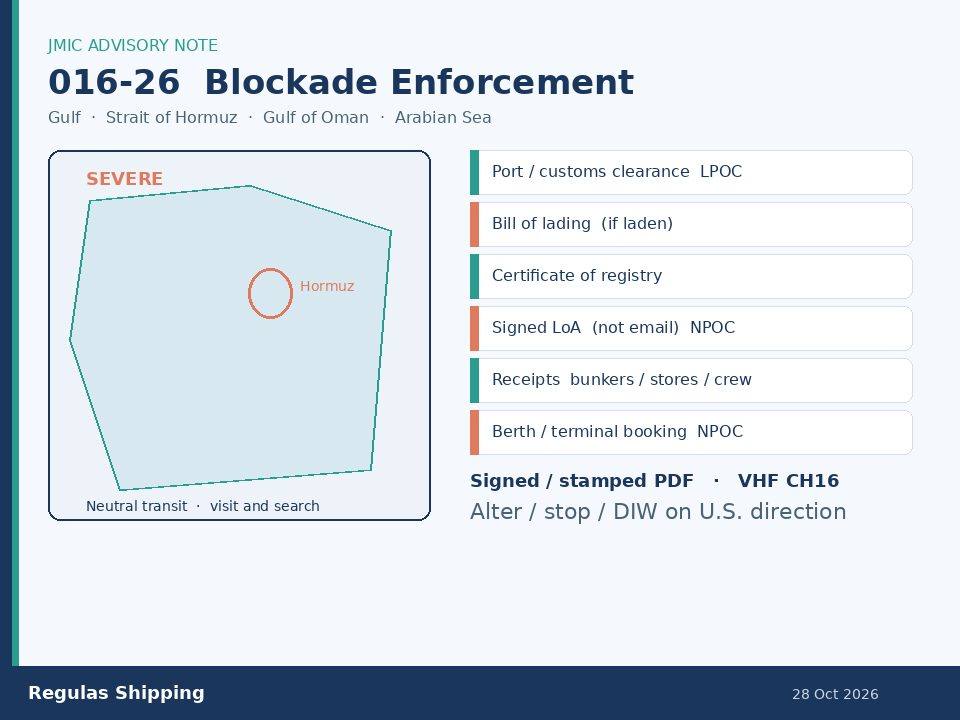
The U.S. Navy-led Joint Maritime Information Center published Advisory Note 016-26, titled Blockade Enforcement, dated 28 October 2026. The working primary is the numbered PDF posted on the UKMTO product board as jmic-advisory-note-01626-blockade-enforcement.pdf. The note is printed as JMIC# 016-26. The regional threat level on the face of the note is SEVERE. The areas of concern are the Gulf, the Strait of Hormuz, the Gulf of Oman and the Arabian Sea. The header tells owners, operators and mariners that the page details U.S. military blockade operations in those waters, with further U.S. NAVCENT information appended. The action line on both the cover strip and the body is the same: vessels are encouraged to communicate with NAVCENT NCAGS at [email protected]. UKMTO remains [email protected] and +44 (0)2392222060.
This is a numbered blockade-enforcement advisory. It is not Update 109. Update 108, JMIC# 001 26, ICOD 251300 UTC 25 October, remains the last numbered public periodic note, with Hormuz SEVERE, the Arabian Gulf SUBSTANTIAL, the Gulf of Oman MODERATE and 156 incidents since 1 March. It is not a rewrite of Advisory Note 015-26, the 14 July 2026 blockade-of-Iranian-ports announcement that set the 2000Z 14 July start, the humanitarian-vetting list and the 30-nautical-mile standoff language. It is not Warning 184-26. UKMTO still ends at 183-26. It is not an International Maritime Organization 122-count. The highlighted-incidents board is still 121 confirmed / 24 seafarer fatalities as at 27 October. Masters who brief Wednesday as a Hormuz reopen, as a new Attack PDF, or as a completed Update 109 will have merged a document-pack advisory into three other series.
What the note actually printed
The confirmed tape is the body of 016-26. The heading is BLOCKADE OF IRANIAN PORTS AND COASTLINES. The United States is enforcing a blockade of all Iranian ports and coastlines in response to Iran’s continued aggression and illegal attempts to control the Strait of Hormuz in violation of International Law. The blockade applies to all vessels regardless of flag or ownership. Neutral vessels, carrying neutral cargo or in ballast, between neutral ports in the Gulf of Oman and the Strait of Hormuz may be subject to questioning, visit and search to confirm their intentions regarding the blockade. Due to the current geopolitical situation, vessels which do not need to transit the area are advised to remain well clear to avoid unnecessary delays to their voyage. Neutral vessels should maintain a continuous listening watch on VHF Channel 16 and follow all directions from U.S. forces. That is the product. Stay with that wording. Do not invent a new CENTCOM redirected-or-disabled tally. 016-26 does not reprint the 17 October CENTCOM line that Update 108 still carries: 138 commercial vessels redirected and four disabled as of 10–11 October.
The new operator content is the boarding pack. Vessels should be prepared to alter or stop their course, or come dead in the water, upon direction from U.S. forces, and have the following documents ready for review on request, as applicable: port/customs clearance from last port of call; bill of lading if laden; certificate of registry; a signed and stamped letter of appointment, not an email, from the agent at next port of call; receipts or signed contracts for provisions, bunkers, spare parts, repairs and/or crew change at next port of call; and terminal, port or berth booking confirmation for next port of call. All documents must be signed or stamped and in PDF format. Vessels transiting the area are advised to plan additional transit time to allow for increased traffic density and military blockade enforcement operations. That six-item list, the PDF-and-stamp rule, the dead-in-the-water instruction and the extra-time line are what 016-26 adds to the public folder. They are not on Update 108. They are not a UKMTO warning. They are not a named-hull Attack.
Hold 015-26 beside this note. The July advisory announced the blockade, printed the 14 July 2000Z start, warned that non-compliant vessels may be legally compelled with force, printed disabling and destructive fire against vessels that do not demonstrate immediate compliance, kept a 30-nautical-mile standoff from U.S. units, set visit-and-search for contraband, and listed a fourteen-point humanitarian-vetting submission to the same NCAGS mailbox. Wednesday’s note does not cancel 015-26. It does not reprint the standoff distance. It does not reprint the humanitarian exemption process. It does not reprint the destructive-fire sentence. A DPA who briefs 016-26 as a quiet replacement of 015-26 has dropped the July force and standoff language without an instrument that withdrew it. A DPA who briefs 016-26 as nothing new because the blockade is already known has under-read a six-document pack that a visit-and-search team can now ask for by name.
Industry colour of public availability is the Newsquawk 09:41 UTC 28 October headline that UKMTO had reported a JMIC update on the Strait of Hormuz, the Gulf of Oman and the Arabian Sea, restating the neutral-vessel visit-and-search sentence and the remain-well-clear advice. That is a wire restating the PDF. It is not a JMIC clock. It is not an ICOD. It is not Update 109. Do not treat 09:41 UTC as the note’s information cut-off. The face of the PDF is dated 28 October 2026. That is the date to log.
What this is not
This is not Update 109. Update 108 remains last numbered periodic note, ICOD 251300 UTC 25 October, 156 incidents since 1 March, one Attack in that report period (181-26, name withheld, LPG tanker, Limah). 182-26 and 183-26 sit after that cut-off and are still not on Update 108. 016-26 does not add them. It does not name Leonora Kosan, Soyia, Chloe, Al Dasma, Ghana Prosperity, Cape Dao or GFS Pride. It does not move Hormuz off SEVERE.
This is not Warning 184-26, and it is not a rewrite of 183-26, 182-26 or 181-26. UKMTO still ends at 183-26, the 26 October Suspicious Activity fire 63 nautical miles southeast of Al-Faw. 182-26 remains Monday’s dedicated outbound-Hormuz Attack with a disablement line. 181-26 remains Friday’s dedicated unnamed tanker Attack 7 nautical miles northeast of Limah, later typed as an LPG tanker on Update 108 and named Leonora Kosan on Tuesday’s dedicated IMO 121-count. 016-26 prints none of those hulls.
This is not an IMO 122-count. The board is still 121 / 24 as at 27 October, with Leonora Kosan still the newest named row. 176-26, 182-26 and 183-26 remain unnamed on that board. 016-26 does not fill those slots. This is not a Hormuz closure and not a Hormuz reopen. Neutral transit between neutral ports is still the published path. Questioning, visit and search are still the published tools. The note tells vessels that do not need the transit to stay out so they do not collect delay. That is congestion and enforcement advice. It is not a TSS shutdown.
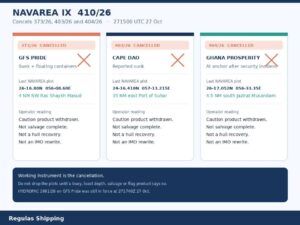
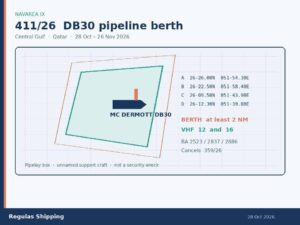
This is not this morning’s dedicated NAVAREA IX 410/26 cancel of the GFS Pride, Cape Dao and Ghana Prosperity cautions, and it is not the same-clock Qatar works in 411/26 and 412/26. Do not merge a Central Gulf pipeline box or a three-product wreck-caution cancel onto a blockade document list. PGSA’s 123-vessel non-compliance list, Paris MoU’s LIRA refusal and Tokyo MoU Safety Bulletin 05/26 remain their dedicated files.
Operational implications
For a master already in the Fujairah, Khor Fakkan, Musandam or Sohar density printed on Update 108, Wednesday is a bridge-folder problem before it is a policy problem. The visit-and-search list is now specific. Last-port clearance, bill of lading, registry, a wet-ink or stamped letter of appointment from the next-port agent, bunker and repair receipts tied to that next port, and a berth or terminal booking are to be in signed or stamped PDF, ready when U.S. forces hail on Channel 16 and tell the ship to alter, stop or come dead in the water. An emailed agency appointment, a screenshot, or a booking that only exists in a charterer’s chat will not match the note. The extra-time line is also specific. Passage plans that treated U.S.-facilitated transits as a 28-a-day NCAGS conveyor, against Update 108’s single-digit independent flow and roughly 492 vessels waiting outside Hormuz on 25 October, now have to carry delay for questioning and search, not only for projectile risk and GNSS interference.
For a DPA and an operator with ships that still intend a neutral Gulf of Oman to Strait of Hormuz run, the six documents have to exist before the ship is in the hail. The letter of appointment has to be signed and stamped by the next-port agent, not drafted in the office as an email. The receipts have to tie provisions, bunkers, spares, repairs or a crew change to that next port. The berth booking has to be a terminal, port or berth confirmation, not a hoped-for window. Ships that do not need the waterway are told to stay out. That is a commercial instruction as well as a safety one: a ballast voyage that can wait, or a Gulf call that can be stemmed from Fujairah without a Hormuz transit, is the note’s remain-well-clear option. Humanitarian cargo to Iran remains the 015-26 / 003-26 vetting path through the same NCAGS mailbox. 016-26 does not reprint that fourteen-point list. Do not treat the six-document pack as a substitute humanitarian licence.
For charterers and P&I, Wednesday is a delay-and-documents file, not a new Attack. Off-hire, deviation and extra-war-risk conversations will now ask whether the ship had the six PDFs on board, whether it came dead in the water when directed, and whether the voyage actually needed the area. They will not be answered by Update 108’s 138/4 CENTCOM line, by Tuesday’s 121-count, or by this morning’s 410/26 cancel. Flag, class and the NCAGS mailbox remain the enforcement contacts printed on the note. UKMTO remains the suspicious-activity and Attack reporting centre. Those are different mailboxes.
Keep the dedicated files on their own lines. Update 108 remains the last periodic threat note. 015-26 remains the original blockade announcement, standoff and humanitarian-vetting instrument unless JMIC cancels or supersedes it by number. 183-26, 182-26 and 181-26 remain their UKMTO PDFs. Leonora Kosan remains Tuesday’s IMO naming. 410/26 remains this morning’s three-product cancel. Do not recast 28 October as Update 109, as Warning 184-26, as an IMO 122-count, as a Hormuz reopen, or as a completed CENTCOM tally.
What Operators Should Note
- Log Advisory Note 016-26 as a blockade document pack, not as Update 109. Dated 28 October 2026. JMIC# 016-26. Title: Blockade Enforcement. Regional threat SEVERE. Areas: Gulf, Strait of Hormuz, Gulf of Oman, Arabian Sea. Action: NAVCENT NCAGS
[email protected]. UKMTO[email protected]/ +44 (0)2392222060. This is not Warning 184-26, not an IMO 122-count, and not a Hormuz reopen. - Carry the six PDFs before the hail. Last-port customs clearance. Bill of lading if laden. Certificate of registry. Signed and stamped letter of appointment from the next-port agent — not an email. Receipts or signed contracts for provisions, bunkers, spares, repairs and/or crew change at next port. Terminal, port or berth booking confirmation for next port. All signed or stamped, all PDF. Be ready to alter, stop or come dead in the water on U.S. direction. Keep a continuous watch on VHF Channel 16.
- Hold 015-26 beside 016-26. The July note still carries the 14 July 2000Z start, disabling and destructive fire for non-compliance, the 30-nautical-mile standoff from U.S. units, and the fourteen-point humanitarian-vetting list. Wednesday does not cancel that paper. Wednesday does not reprint the standoff or the humanitarian process. Do not drop July’s force language because October printed a document list.
- Plan delay, and stay out if the transit is optional. Neutral vessels between neutral ports remain subject to questioning, visit and search. Vessels that do not need the area are advised to remain well clear to avoid unnecessary delay. Extra transit time is printed for traffic density and blockade enforcement. Update 108’s 25 October congestion — about 194 at Fujairah/Khor Fakkan, about 492 waiting outside Hormuz — is still the last numbered density line. 016-26 does not clear it.
- Do not invent a new CENTCOM tally or a new Attack from this note. 016-26 reprints no redirected, disabled or boarded count. Update 108 still cites 138 redirected and four disabled as of 10–11 October, dated 17 October. UKMTO still ends at 183-26. IMO still 121 / 24 as at 27 October. 176-26, 182-26 and 183-26 remain unnamed on that board.
- Leave this morning’s NAVAREA products on their own files. 410/26 remains the Pride / Cape Dao / Ghana Prosperity cancel. 411/26 and 412/26 remain same-clock Qatar works. PGSA 123, Paris MoU LIRA and Tokyo MoU 05/26 remain their dedicated pieces. Watch a later JMIC note that cancels 015-26, reprints a new CENTCOM tally, or actually issues Update 109 — not a headline that Wednesday reopened Hormuz.
Regulas Shipping will keep lining Advisory Note 016-26 against 015-26 and Update 108 so operators can treat Wednesday’s note as a visit-and-search document pack and a delay instruction, not as Update 109, a new Attack PDF or a completed blockade reopen.