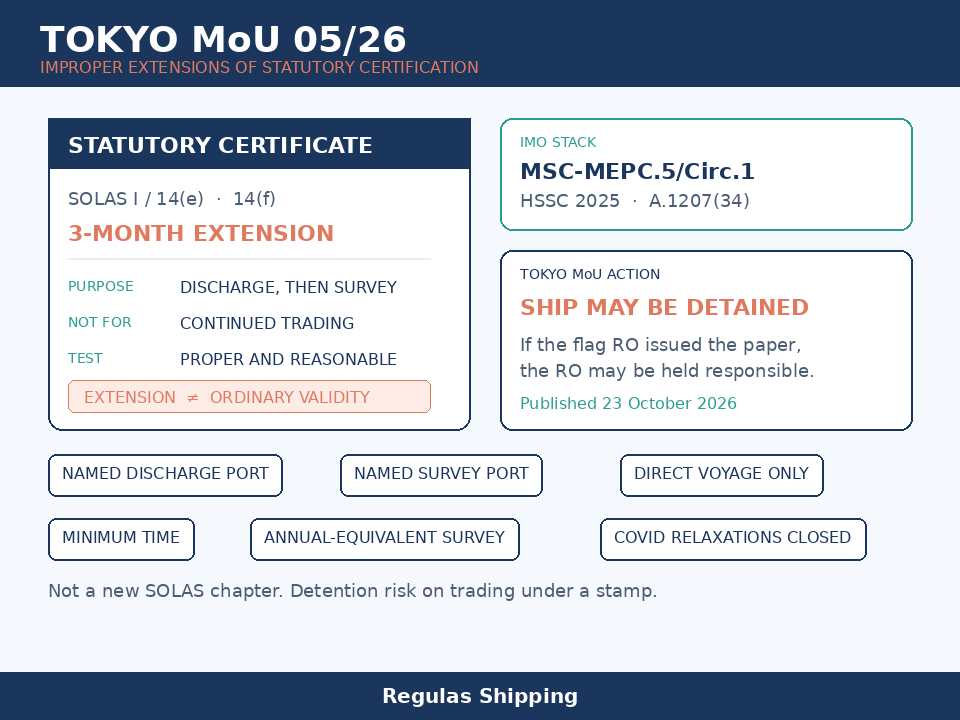
The Tokyo Memorandum of Understanding on Port State Control published Safety Bulletin 05/26, titled Improper extensions of Statutory Certification, on 23 October 2026. The working primary is that numbered bulletin on the Tokyo MoU safety-bulletin and publications lists. The bulletin states the position of Tokyo MoU member authorities on when statutory certification may be extended under international conventions, including but not limited to the International Convention for the Safety of Life at Sea. It describes what port State control officers are finding and what the memorandum will do. The named audience is shipowners and operators, surveyors and Recognised Organisations, masters and ships’ officers, and maritime administrations, their officers, investigators and technical advisers. Industry reprints on 24 October carried the same title, the same three-condition acceptance test, the same SOLAS Chapter I Regulation 14(e) and (f) finding, and the same detention-and-RO-responsibility line. That listing, and not a new SOLAS amendment, is the working primary for this piece.
This is a Port State Control enforcement bulletin on certificate extensions. It is not a rewrite of the dedicated Paris and Tokyo MoU cargo-securing Concentrated Inspection Campaign pieces, which remain the 1 September–30 November questionnaire file. It is not a rewrite of the dedicated U.S. Coast Guard NVIC 02-26 cybersecurity-plan guidance. It is not a Hormuz Attack, not Update 108, and not a Black Sea wreck notice. Operators who brief this week as a new convention, as a blanket three-month trading window, or as a Tokyo MoU finding against a named hull have over-read the instrument. Operators who brief it as optional colour with no detention risk have under-read the action paragraph.
What the bulletin actually says
The risk paragraph is the first briefing fact. Extending statutory certificates beyond established requirements is not, on the Tokyo MoU wording, merely an administrative or certification matter. It is linked to verification of a ship’s ongoing compliance, condition and maintenance regime. The bulletin records that the impact of the COVID-19 pandemic on ship maintenance programmes is well documented, and that many ships are only now approaching their first scheduled drydocking cycle since that period. Deferring non-critical maintenance to a planned drydocking is treated as common industry practice only where the ship remains inside approved survey and certification intervals. Allowing ships to continue commercial operations beyond agreed drydocking and survey intervals introduces, on this text, avoidable risk to maritime safety and environmental protection. Port and coastal States, the bulletin says, should not be expected to accept that risk where operators have had reasonable opportunity to plan and complete the required surveys, maintenance and drydocking.
The legal stack is the second briefing fact. The International Maritime Organization’s recommendations to administrations on extending certificate validity sit in MSC-MEPC.5/Circ.1. The Survey Guidelines under the Harmonized System of Survey and Certification (HSSC) 2025, IMO Resolution A.1207(34), provide the framework for extending a certificate when it is “proper and reasonable to do so,” at paragraph 5.9.1. Under that framework, extension decisions should consider whether the ship will sail directly to a named final agreed cargo discharge port and then directly to a named agreed port to complete the survey and/or dry-docking. Tokyo MoU member authorities say they can only accept an extension if all of the following conditions are met: the extension is granted under a regulation in a Convention, an Annex to a Convention, an Article of a Convention, or a Code with a limited time requirement; it is for the purpose of allowing a ship to complete its voyage to a final cargo discharge port, then directly to the port in which it is to be surveyed, and is not to be used to continue commercial operations; and it appears proper and reasonable to do so, with paragraph 5.9.2 as the basis for that judgment. An extension is not, on this bulletin, an additional period of ordinary certificate validity.
Where a ship is at a port where the required survey cannot be completed, and the Convention permits the Administration to extend the certificate, MSC-MEPC.5/Circ.1 still supplies the eight-point guide the bulletin reprints. An additional survey equivalent to at least an annual survey should be carried out. If a renewal survey is due, it should be progressed to the maximum extent possible. If dry-docking is required but cannot be conducted, an underwater inspection of the ship’s bottom should be carried out; if that is not possible, an internal inspection of the bottom structure should be carried out to the maximum extent practicable. The ship should be permitted to sail directly to a named final agreed cargo discharge port and then proceed directly to a named agreed port to complete the survey and/or dry-docking. The extension period should be the minimum time required. The condition found on those surveys should shape duration, distance and any operational restrictions. The extension period should not exceed the validity of the new certificate that may be issued for structural, mechanical and electrical compliance with the recognized classification society.
What officers are finding
Port State control officers, the bulletin says, are finding ships whose statutory certificates have been extended under SOLAS Chapter I, Regulation 14(e) or (f), that continue to trade commercially and do not proceed directly to the port of survey. Officers are seeing three-month extensions on ships that continue, or intend to continue, commercial trading for that period. Those ships are not undertaking a direct voyage to their named cargo discharge and/or survey port. The extensions run for more than the minimum time needed to complete the survey. The ships usually require dry-docking as part of the outstanding survey. That is the finding. The bulletin does not print a named hull, a flag table, a detention count, or a Recognised Organisation league. Do not invent one.
COVID-era relaxations are closed colour, not a current defence. The bulletin acknowledges that during the pandemic the IMO granted relaxations in Circular Letter No. 4204/Add.19 because of government restrictions. It then states that reliance on those temporary relaxations has been withdrawn as normal statutory survey and certification procedures have been reinstated. A DPA who briefs a 2026 three-month trading extension as “the same flexibility we used in 2020” has used a circular the Tokyo MoU says is no longer available for that purpose.
The action paragraph is short. Where a ship is found to have its statutory certificates extended contrary to a Convention or Code requirement, the ship may be detained as part of a port State control inspection. Where a flag State’s appointed Recognised Organisation issued the extension, the RO may be held responsible for such detention. That is the enforcement line. It is not an automatic detention of every ship that holds any short-term extension. It is not a finding that a properly conditioned, convention-based, direct-to-discharge-then-survey extension is illegal. It is a warning that a three-month paper used as extra trading time is inside the Tokyo MoU detention envelope, and that the RO that signed it can be pulled into the same file.
Operational implications
For an owner or DPA with a ship due for renewal or dry-docking that still has Asia-Pacific port calls before the yard date, 23 October is a voyage-order problem, not a new convention. If the flag or the RO has already issued a SOLAS I/14(e) or (f) extension, the questions a Tokyo MoU boarding will ask are now printed: is there a named final cargo discharge port; is there a named agreed survey or dry-docking port; is the ship on a direct voyage between those two; is the period the minimum required; was an annual-equivalent additional survey done; if the bottom cannot be seen, was an internal bottom inspection done; and does the paper still look like extra trading time. A ship that loads a further commercial stem after the extension date, or that wanders the region looking for cargo under a three-month stamp, is the pattern the bulletin says officers are already writing up. Charterers who fix that hull for a third load after the original discharge have a detention and off-hire problem as well as a survey problem.
For a Recognised Organisation and a flag administration, Thursday is a signature problem. The bulletin puts the RO on the detention if the RO issued the extension. That is a quality and reporting exposure, not only an owner exposure. Surveyors who have been treating Regulation 14(e) or (f) as a routine three-month rollover need the three-condition test in the file before the next endorsement. Administrations that have been signing extensions without a named discharge port and a named survey port are the other half of the same finding. The HSSC 2025 “proper and reasonable” language at 5.9.1 and 5.9.2 is the decision record the Tokyo MoU says it will read against.
For a master, the practical pack is the certificates, the extension letter, the additional-survey report, the named discharge port, the named yard or survey port, and a voyage plan that actually goes there. If the paper says “proceed to Singapore for dry-docking” and the next fixture is a coastal stem in another sea, the boarding officer already has the bulletin’s finding in front of them. Do not brief the crew that a three-month stamp is ordinary validity. Do not treat an overdue dry-dock as a commercial option because cargo is available.
Keep the dedicated files on their own lines. The Paris and Tokyo cargo-securing CIC, 1 September to 30 November, remains the questionnaire-and-detention-risk file for lashing, CSM, VGM and CSAP. NVIC 02-26 remains the dedicated MTSA cybersecurity-plan guidance. Japan’s 2 October vessel-level permit list and the Tokai Kisen suspension order remain those dedicated files. This bulletin does not name those instruments and does not change Update 108, Warning 182-26, or ARN 155/2026. Do not merge a PSC certificate fight onto a Hormuz Attack.
Do not recast 23 October as a new SOLAS chapter, as a completed Tokyo MoU detention table, as a named-hull finding, as a rewrite of the cargo-securing CIC, or as a reopening of Circular Letter 4204/Add.19. The confirmed facts are Safety Bulletin 05/26, 23 October 2026, improper extensions of statutory certification, three-condition acceptance test, MSC-MEPC.5/Circ.1 and HSSC 2025 A.1207(34) as the IMO stack, SOLAS I/14(e) and (f) three-month extensions used for continued trading as the finding, detention and RO responsibility as the action, and no named ship on the public bulletin.
What Operators Should Note
- Log Safety Bulletin 05/26 as a Tokyo MoU detention warning, not as a new convention. Official title: Improper extensions of Statutory Certification. Published 23 October 2026 on the Tokyo MoU safety-bulletin list. Audience: owners, ROs, masters and administrations. An extension is not an extra period of ordinary certificate validity. It may be granted only for the limited purpose the applicable Convention allows, and only where the Administration judges it proper and reasonable.
- Apply the three-condition test before the next Asia-Pacific call. The extension must sit under a Convention, Annex, Article or Code with a limited time requirement. It must take the ship to a named final cargo discharge port and then directly to a named agreed survey or dry-docking port, not into further commercial trading. It must be proper and reasonable under HSSC 2025 paragraph 5.9.2. Missing any one of those three is the pattern officers say they are already seeing on SOLAS I/14(e) and (f) three-month stamps.
- Keep the eight MSC-MEPC.5/Circ.1 points in the extension file. Annual-equivalent additional survey. Renewal survey progressed as far as possible. Underwater bottom inspection if dry-docking cannot be done, or internal bottom inspection if the water will not allow it. Direct voyage only. Minimum time. Condition-based limits on duration, distance and operations. Extension no longer than the new class certificate that would document structural, mechanical and electrical compliance. A letter without those attachments is a weak boarding pack.
- Do not use pandemic relaxations as the 2026 defence. Circular Letter No. 4204/Add.19 is acknowledged and then closed. The bulletin says those temporary relaxations have been withdrawn. Many ships are only now reaching their first post-pandemic dry-docking cycle. That background explains the finding. It does not authorise another three months of trading.
- Treat detention and RO responsibility as live outcomes. A ship found with certificates extended contrary to the Convention or Code may be detained. If the flag’s appointed Recognised Organisation issued the extension, the RO may be held responsible for that detention. Charterers who fix a hull that is already on an extension for a further commercial stem take that risk into the fixture.
- Leave the cargo-securing CIC and NVIC 02-26 on their dedicated pieces. The Paris/Tokyo CIC through 30 November remains the lashing and CSM questionnaire. NVIC 02-26 remains the MTSA cyber-plan playbook. This bulletin is a statutory-certificate extension file. Watch a named Tokyo MoU detention, a flag or class implementing note, or a published RO performance action — not a headline that Thursday invented a new SOLAS chapter.
Regulas Shipping will keep lining Safety Bulletin 05/26 against MSC-MEPC.5/Circ.1 and the HSSC 2025 extension test so operators can treat this week’s Tokyo MoU note as a detention risk on commercial trading under a three-month stamp, not as extra ordinary validity or a new convention.