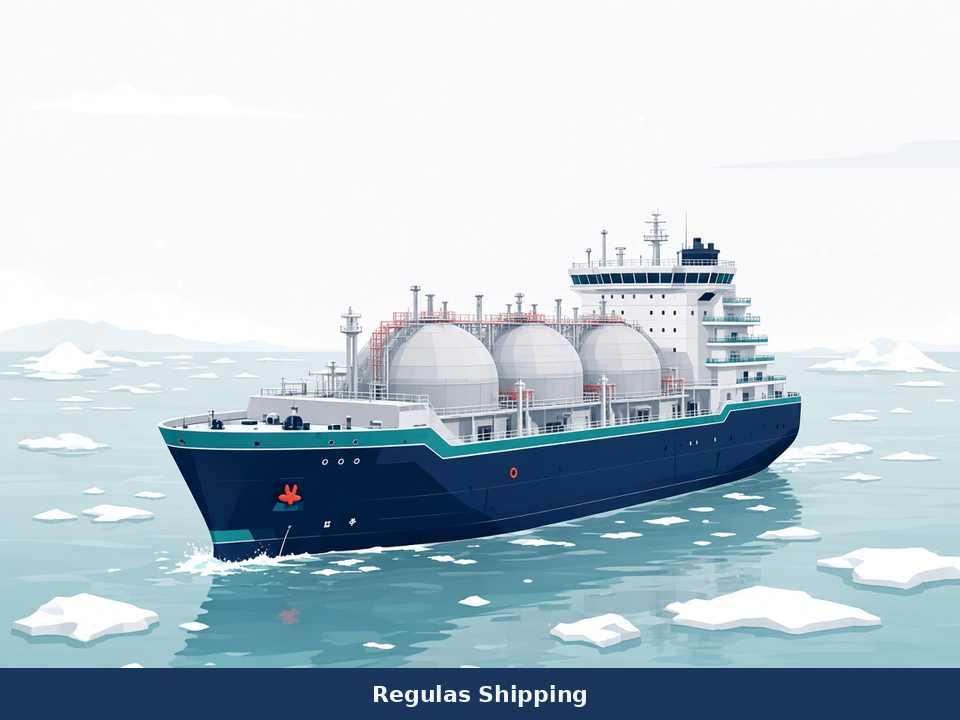
The United Kingdom’s Foreign, Commonwealth and Development Office added eight ships to the Russia sanctions list on Thursday, 1 October. Five of them are liquefied-natural-gas carriers: Chaivo, Portovyy, Aleksey Kosygin, Konstantin Posiet and Pyotr Stolypin. The same notice also specified Avacha and two smaller support ships, Galle Energy and Bebek-E. All eight are subject to shipping and trade sanctions under the Russia (Sanctions) (EU Exit) Regulations 2019. The package as a whole comprises 23 individuals and entities plus the eight ships. gCaptain’s Malte Humpert, writing the same day, treated the five named LNG carriers as the operational centre of the maritime file.
This is a designation list, not a Hormuz product and not a rewrite of earlier shadow-fleet boardings. The useful facts for a DPA, a commercial manager and a P&I desk are the named IMOs, the UK-port and UK-services prohibitions that attach immediately, and the separate 1 January 2027 maritime-transport ban on Russian LNG that the same day’s Japan and South Korea general trade licences are written around. Do not read Thursday’s list as a worldwide port closure, and do not read Friday’s correction notice as a delisting.
What the 1 October notice actually prohibits
Each ship is specified under regulation 57F for the full shipping stack: a prohibition on chartering or operating the specified ship (57ZA); a prohibition on port entry (57A); directions that can bar port entry (57B), move the ship (57C) or detain it (57D); and termination of any UK Ship Register entry (57E). Where those shipping sanctions all apply, the ship must not be chartered or operated, must not be given access to a UK port, and a master or pilot may be given a barring, detention, entry or movement direction.
The trade stack sits beside it. Regulation 46AA and 46AB make it an offence to provide, or to procure, technical assistance, crew services, operating services, chartering services, brokering services, financial services or funds in relation to a specified ship, and to provide services relating to the acquisition, sale, transfer or supply of that ship. The prohibition is on UK persons and UK-nexus services. It is not a flag-state deletion and it is not an order to every non-UK port. A compliance officer still has to treat a UK insurer, broker, technical manager, crew agent or financier on any of the eight hulls as a live exposure from 1 October.
The FCDO’s public note described the eight ships as three shadow-fleet vessels, two vessels providing them with bunkering services, and three Russian-owned ice-class vessels. The 1 October sanctions notice is the document that names them. Stay with that notice for IMO, operator and reason. Do not collapse the five LNG carriers into one Arctic class, and do not invent oil cargoes where the statement of reasons is LNG.
Five LNG carriers, three of them Arc7
Chaivo, IMO 9331048, unique ID RUS3734, is listed as a Russia-flag LNG tanker of about 97,491 gt and 285 metres, built 2007. Current owner-operators in the notice are Tudor Maritime Ltd and CryoLine Management LLC; previous owner-operators are Maran Gas Maritime Inc and Angelicoussis Shipping Group. The statement of reasons is that the ship has been, is, and is likely to continue to be involved in carrying LNG that originated in Russia from a place in Russia to a third country.
Portovyy, IMO 9246621, unique ID RUS3735, is listed as a Russia-flag LNG tanker of about 94,499 gt and 277 metres, built 2003, current owner-operator PJSC Gazprom. The reason is the same LNG-carriage ground. gCaptain added market colour that is not in the notice and should stay labelled as such: the ship had served as floating storage at Gazprom’s Portovaya plant in the Baltic since 2022 and made an unusual eastbound Northern Sea Route voyage to China this summer. That voyage is context for why London put a conventional hull on the same tape as the new ice-class ships. It is not a UK finding that every Portovaya cargo is now a listed-ship movement.
Aleksey Kosygin, IMO 9904546, unique ID RUS3736, is listed as a Russia-flag LNG tanker of about 127,555 gt and 300 metres, current owner-operators Novatek and SPG Shipping. Konstantin Posiet, IMO 9904704, unique ID RUS3737, is listed on the same tonnage and length, built 2026, current owner-operators Novatek and SPG Shipping-2. Pyotr Stolypin, IMO 9904675, unique ID RUS3738, is listed at about 108,406 gt and 300 metres, built 2026, current owner-operator Novatek. The first two statements of reasons use the same “has been, is, and is likely to continue” LNG-carriage language. Stolypin’s reason is narrower and should be briefed that way: the Secretary of State suspects the ship is likely to be involved in carrying Russian-origin LNG to a third country. gCaptain, citing Rosneft, said the hull was still being prepared for sea trials at Zvezda in September. London is listing capacity before the first commercial cargo, not waiting for an AIS track.
gCaptain identified Kosygin, Posiet and Stolypin as Arc7 ice-class ships built for Novatek’s Arctic LNG 2 programme, with Kosygin delivered in December 2025, Posiet named in June 2026, and Posiet already reported as having used the Northern Sea Route to load at the Utrenneye terminal. Treat those class and delivery facts as industry matching on the three ice-class names in the FCDO note. They are not a substitute for the IMO list. The notice’s year-built field on Kosygin reads 2005; do not use that figure to argue the ship is a 20-year-old conventional tanker. The IMO, the operator line and the Arc7 matching are the working identifiers.
Avacha, Galle Energy, Bebek-E — and Friday’s correction
Avacha, IMO 9319404, unique ID RUS3746, is listed with current owner-operator Tudor Maritime Ltd and a believed Russia flag. The 1 October reason is again Russian-origin LNG to a third country. It is the third conventional LNG name on the tape after Chaivo and Portovyy, and it shares a Tudor Maritime operator line with Chaivo.
Galle Energy, IMO 9344411, was listed on 1 October as unique ID RUS3747, Sri Lanka flag, current owner-operator Sharaf Shipping Agency LLC, with an LNG-carriage statement of reasons. Bebek-E, IMO 7808401, unique ID RUS3739, was listed as Turkey flag, current owner-operator Alasonya Denizcilik Tic Ltd, about 2,300 gt, built 1979. The FCDO’s accompanying note is the source that calls those two the bunkering ships. A second sanctions notice on Friday, 2 October, revoked and remade both specifications under new unique IDs — RUS3751 for Galle Energy and RUS3752 for Bebek-E — to correct the statement of reasons. The Virgin Islands Financial Services Commission’s Circular 83, issued the same day, said the error was in the reasons and that shipping and trade sanctions remained in force. The remade reason is that each ship is, has been, or is likely to be involved in activity whose object or effect is to obtain a benefit from or support the Government of Russia. Friday is a reason correction, not a licence to resume UK services.
The 1 January 2027 maritime-transport restriction is a different clock. On 20 May 2026 the UK prohibited UK-business involvement in the maritime transportation of Russian LNG. From 1 January 2027 that prohibition extends to trade under long-term contracts concluded before 17 June 2025. The same 1 October package published two general trade licences, for Japan and for South Korea, that take effect on that date and expire on 31 March 2028. They authorise UK persons to carry or deliver Sakhalin-2 LNG to those two countries, and to provide related financial, brokering and specified legal-advisory services, only where the supply contract was concluded before 17 June 2025. Users must notify the Office of Trade Sanctions Implementation within 30 days of the activity beginning and keep records. The licences do not authorise trade with designated persons and do not authorise new contracts. They are not a waiver for Chaivo, Portovyy, Kosygin, Posiet, Stolypin, Avacha, Galle Energy or Bebek-E.
What this does not change
A UK listing does not by itself close a Russian load port, a Chinese discharge, or a Northern Sea Route transit. It does put a UK-nexus service ban on named hulls that Arctic LNG 2 and Portovaya programmes will want to use, and it puts a dated end on UK insurance and maritime services for Russian LNG more generally. Operators who still have UK P&I, hull, broking, crew or technical-management exposure on Russian-origin LNG need a ship-by-ship screen against the eight IMOs now, and a contract-date screen against 17 June 2025 before 1 January 2027. Japan and South Korea Sakhalin-2 stems that fit the licences still have to keep designated ships and designated counterparties out of the chain.
Do not fold this package into the Hormuz projectile file, the Persian Gulf Strait Authority declaration channel, or the 26 September Suez-count piece. Those are kinetic, coastal-state and container-routing products. Thursday’s notice is a UK sanctions instrument with named LNG hulls. Do not recast it as an already-effective worldwide LNG embargo, as a delisting of Galle Energy or Bebek-E, or as proof that Arctic LNG 2 has stopped loading.
What Operators Should Note
- Screen the eight IMOs from 1 October, not from 1 January. Chaivo 9331048 (Tudor Maritime / CryoLine, Russia, ~97,491 gt); Portovyy 9246621 (Gazprom, Russia, ~94,499 gt); Aleksey Kosygin 9904546 (Novatek / SPG Shipping); Konstantin Posiet 9904704 (Novatek / SPG Shipping-2, 2026); Pyotr Stolypin 9904675 (Novatek, “likely to be involved,” not a completed cargo finding); Avacha 9319404 (Tudor Maritime, Russia); Galle Energy 9344411 (Sharaf Shipping Agency, Sri Lanka); Bebek-E 7808401 (Alasonya, Turkey, 1979, ~2,300 gt). UK port entry, chartering, operation, crew, technical, broking and financial services on those hulls are prohibited for UK persons now.
- Treat Friday’s notice as a reason correction, not a release. Galle Energy moved to unique ID RUS3751 and Bebek-E to RUS3752 on 2 October. The restated ground is benefit to or support for the Government of Russia. Shipping and trade sanctions stayed on. Do not resume a UK service on the strength of the revoked LNG-carriage wording.
- Keep Stolypin on the list even if it is still at the yard. The notice uses “likely to be involved.” gCaptain’s Zvezda sea-trial colour does not take the IMO off the specification. A pre-delivery hull can still create a UK-services problem for anyone arranging crew, stores, class, insurance or a first charter.
- Separate the named-ship ban from the 1 January 2027 LNG-services ban. The May 2026 maritime-transport prohibition widens on 1 January 2027 to pre-17 June 2025 long-term contracts. The Japan and South Korea general licences, issued 1 October, run 1 January 2027 to 31 March 2028, Sakhalin-2 only, old contracts only, OTSI notification in 30 days, no designated-person trade, no new contracts. They do not licence a listed ship.
- Map the UK nexus before the next fixture, not after the first claim. UK P&I, hull war, brokers, crew managers, technical managers and banks on Russian-origin LNG need an IMO screen and a contract-date screen. A non-UK flag and a non-UK discharge do not remove a UK person from 46AA / 46AB.
- Keep this off the Hormuz, PGSA and Suez desks. It does not reopen a strait, legalise a coastal-state declaration, or change a Red Sea routing order. CSO, compliance and underwriters own the eight IMOs until a licence, a delisting or a further OFSI / OTSI note says otherwise.
Regulas Shipping will keep lining the 1 October ship list and Friday’s Galle Energy / Bebek-E correction against the 1 January 2027 LNG-services start date so operators can treat the five named carriers and the three support ships as a live UK-sanctions screen, not as a completed Arctic embargo or a reason to assume Sakhalin-2 cover is unrestricted.