US Energy Secretary Chris Wright said in New York on 19 October that investors may buy idle sanctioned tankers, refurbish them and put them into lawful trades carrying non-sanctioned crude, provided each transaction clears a Treasury approval process. He spoke at a Citadel Securities event. Bloomberg carried the remarks the same evening. World Ports printed the English operator read on 20 October. Safety4Sea published its wrap at 09:20 UTC on Tuesday. This is a public-remarks file on a case-by-case OFAC route. It is not a named general licence, not a blanket delisting of the dark fleet, and not a Hormuz reopen.
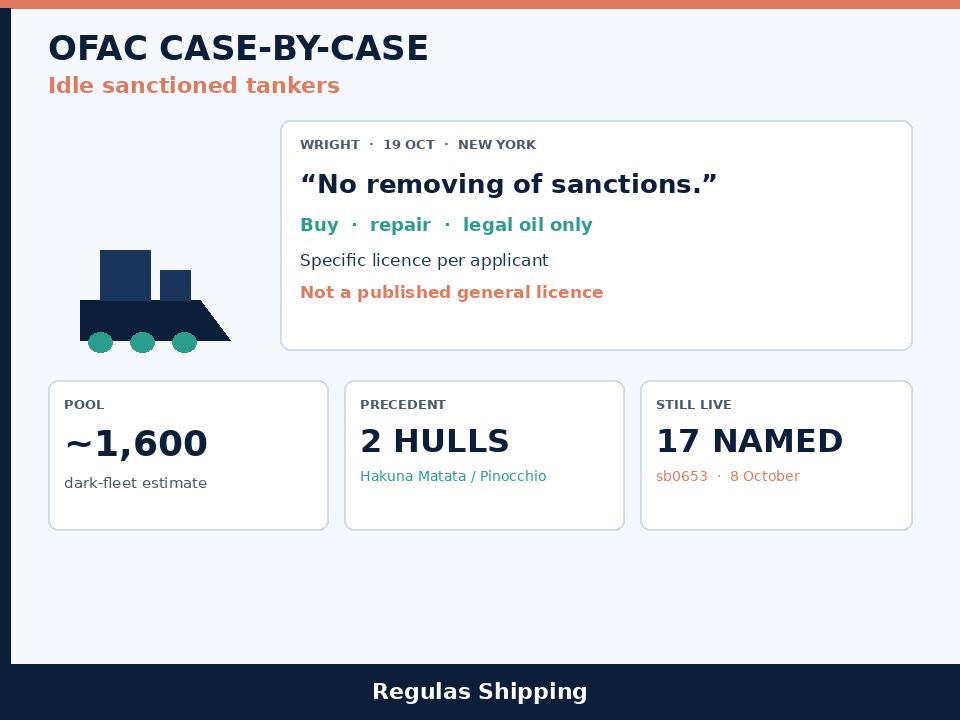
Wright put a size on the pool he was talking about. He estimated about 1,600 vessels in the global dark fleet that have moved Venezuelan, Iranian and Russian oil, and said a large number of those hulls are idle. Prospective buyers, he said, have approached US authorities offering to purchase the ships, repair them and operate them legally. “We’re going to move some of the ships from what I call the ‘bad-guy fleet’ to the ‘good-guy fleet’,” he said. “They will not carry sanctioned oil anymore. There’s an approval process to go through — and it is a source of ships.” He rejected the idea that Washington was simply lifting sanctions off the fleet. “We’re converting dark tankers to legitimate tankers,” he said. “There’s no removing of sanctions.”
World Ports, citing the same remarks, is plainer on the legal instrument that would actually move a hull. A prospective buyer must obtain approval from the US Treasury Department. The Office of Foreign Assets Control can authorise a transaction and consider removing sanctions from an individual vessel on a case-by-case basis when a legitimate buyer intends to return it to lawful commercial service. Specific OFAC licences apply to individual applicants and transactions. They do not provide general authorisation for the sanctioned fleet. Wright did not publish approval criteria, a vessel list, a timeline, or the number of applications already in hand. He said dozens to hundreds of tankers could ultimately return to legitimate trades and that the process would take time. Do not brief Monday’s remarks as an already-issued general licence or as a completed SDN wipe.
What is already on a numbered Treasury product
Hold Wright’s 19 October remarks beside the last numbered OFAC maritime instrument, not on top of it. On 8 October, Treasury press release sb0653, issued under Operation Economic Outcast and E.O. 13902, designated 17 shadow-fleet vessels that it said had carried Iranian crude, petroleum products and petrochemicals to South and East Asia. The named hulls include the Panama-flagged BITU, IMO 9531765; STARWAY, IMO 9273246; and MACKEREL, IMO 9234628 — the three ships the Panama Maritime Authority later restricted and put into ex-officio cancellation under Executive Decree No. 512. Those cancellations remain in process on the dedicated AMP file. They are not a Wright conversion, and they are not a completed Panama strike-off.
The same 8 October product already showed that OFAC will take a ship off the SDN List when it is satisfied the facts have changed. Treasury removed HAKUNA MATATA, IMO 9354167, and PINOCCHIO, IMO 9400112, which it had identified in June 2025 as part of Iran’s shadow fleet, after what it called a demonstrated change in circumstances: removal from that fleet and sale to non-sanctioned, US-aligned operators. That is two named delistings on a numbered press release. It is the closest official precedent for the route Wright described. It is not a general licence, and it is not a statement that the other 17 hulls designated the same day are eligible. Wright’s remarks are the first detailed public explanation from the Energy Secretary that the administration wants that one-hull path used more widely on idle steel. They do not reprint sb0653, and they do not name the next two ships.
The 8 October designation list remains live. PARITOSH, GAS LUCKY, G SPRING, KANHA, KING CHAIN, POLAR, GAS MARAKUA, ZIXUAN, AVA 6, TINA 5, SOGL, NOBLE SEA, SHENZHEN and EXFLAME sit on that product with BITU, STARWAY and MACKEREL. Thirteen owning or operating companies were designated for operating in Iran’s petroleum or petrochemical sector, and five more for the petrochemical sector. Secondary-sanctions exposure for foreign financial institutions that knowingly conduct a significant transaction for a designated person is unchanged. A charterer, technical manager or insurer that treats Monday’s remarks as a green light to pick up any idle sanctioned tanker without a specific licence will have misread both instruments.
Operational implications
For a DPA screening tankers, a technical manager asked to take on a recently idle hull, or a charterer looking at distressed VLCC and products tonnage after the Hormuz disruption, 19 October is a political description of a licence path, not a class certificate. Wright’s own words keep the sanctions architecture in place. Conversion, in the sense he used it, means a new, legitimate owner, a Treasury approval, and a promise that the ship will carry only non-sanctioned oil. The steel can be the same. The SDN status does not flip because an Energy Secretary described the process on a stage. Until OFAC issues a specific licence or a named delisting for that IMO number, the vessel remains a sanctioned asset for US persons and for anyone who would cause a US person to deal in it.
The maritime-safety overlay is the part Wright did not address. Industry analysts quoted in the Tuesday Safety4Sea wrap pointed at ageing hulls, uncertain seaworthiness, and gaps in classification, insurance and maintenance. A ship that has spent years outside IACS class, outside International Group P&I and outside ordinary port-state-control patterns is not made SOLAS- or MARPOL-compliant by an OFAC stamp. A buyer who obtains a specific licence still has to put the ship through survey, repair and certification before a quality charterer, a first-rank insurer or a responsible flag will touch it. Flag administrations that have been cancelling sanctioned tonnage — Panama’s 8 October AMP notice on BITU, STARWAY and MACKEREL is the current example — are not, on this file, offering a fast re-registration for converted hulls. Ask the flag, the class society and the P&I club what they will accept. Do not assume the Treasury paper is enough.
Capacity colour sits around the remarks and should stay colour. Wright tied the idea to a shortage of legitimate tankers after the Iran conflict and the effective closure of the Strait of Hormuz. Bloomberg, as reprinted by gCaptain, recorded Persian Gulf-to-East Asia dirty rates at more than six times the pre-conflict level and Signal Ocean’s count that more than 40 per cent of the world VLCC fleet of about 850 ships was in the Gulf or within a couple of days’ steaming. Those figures explain why buyers are knocking. They do not make an idle sanctioned tanker employable tomorrow. INTERTANKO’s Tim Wilkins, speaking in Paris on 7–9 October, remains the industry colour on this desk: sanctions should disrupt the shadow fleet without disproportionately burdening the compliant fleet, and the quality/shadow line should stay clear. Wilkins’ “wrong signal” line is not a numbered INTERTANKO circular and is not this piece. Do not fold it into Wright as a joint product.
Do not recast 19 October as a named OFAC general licence, a blanket SDN removal, a rewrite of sb0653, a completed Panama cancellation of BITU, STARWAY and MACKEREL, a Hormuz transit product, or a substitute for class, flag and P&I. The confirmed public facts are Wright’s 19 October Citadel Securities remarks, the World Ports and Safety4Sea 20 October operator reads, a described case-by-case specific-licence route at OFAC, an estimated 1,600-ship dark fleet of which some idle hulls might be bought and repaired, and still no published criteria, no new named delistings on Monday, and no general licence number.
What Operators Should Note
- Treat Wright’s remarks as a described licence path, not a general licence. Energy Secretary Chris Wright, Citadel Securities, New York, 19 October. World Ports 20 October. Safety4Sea 09:20 UTC 20 October. He said idle sanctioned tankers can be bought, repaired and put on non-sanctioned oil after an approval process. He also said there is “no removing of sanctions.” Specific OFAC licences are individual. There is no published GL number on this file.
- Screen the IMO number against SDN and the 8 October list before anyone talks “conversion.” Treasury sb0653 of 8 October designated 17 hulls under E.O. 13902, including BITU 9531765, STARWAY 9273246 and MACKEREL 9234628. The same product delisted HAKUNA MATATA 9354167 and PINOCCHIO 9400112 after sale to non-sanctioned, US-aligned operators. That pair is the numbered precedent. It is not a template that automatically covers the next idle tanker a broker offers.
- Keep Panama’s three-ship cancellation on its own sheet. AMP restricted BITU, STARWAY and MACKEREL and opened ex-officio deregistration under Executive Decree No. 512. The process is still under way. A Wright conversion story does not complete those cancellations, and a Panama cancellation does not, by itself, create an OFAC licence for a buyer.
- Do not confuse a Treasury paper with class, flag or P&I. An OFAC specific licence, if one is issued, authorises a transaction that would otherwise be prohibited. It does not survey the hull, restore IACS class, place International Group cover, or prove SOLAS and MARPOL compliance. Ageing idle tonnage will need drydock, steel, equipment and a flag that will take it. Ask those three houses before the commercial recap is circulated.
- Hold dual screening. US, UK, EU, Canadian and other lists still apply. A US-person approval does not clear an OFSI or EU designation on the same IMO number. Secondary-sanctions exposure for a foreign bank that facilitates a significant transaction for a designated person is unchanged on sb0653. Charter, sale and insurance desks should keep both screens, plus beneficial-owner and 50-per-cent rules, until a named licence or delisting appears.
- Leave Hormuz, IRINI and Dutch bill 37038 on their dedicated pieces. Wright’s capacity colour is not a UKMTO warning, not JMIC Update 107, not Council Decision (CFSP) 2026/2243, and not the submitted Dutch EEZ detention text. Watch a named specific licence, a named delisting, or a published OFAC checklist. Until one of those lands, idle sanctioned steel remains idle sanctioned steel.
Regulas Shipping will keep lining Wright’s 19 October case-by-case remarks against Treasury sb0653 and the two named 8 October delistings so operators can treat the conversion talk as a specific-licence path that has not yet become a general licence or a blanket SDN wipe.