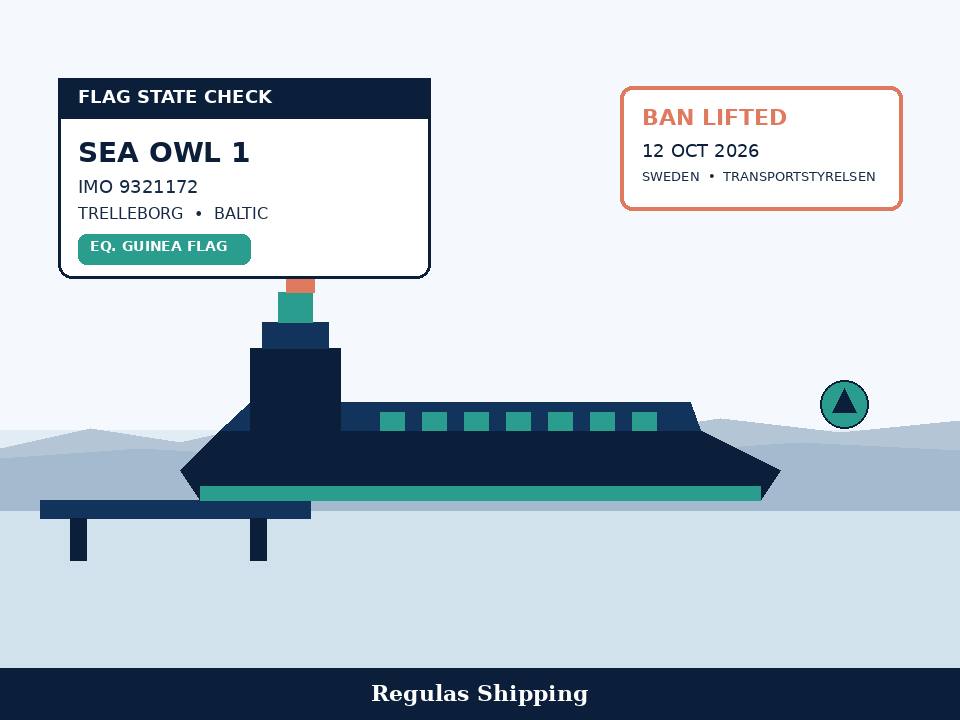
The Swedish Transport Agency lifted the operating ban on the oil-products tanker Sea Owl 1 on Monday morning, 12 October, after Equatorial Guinea confirmed that the hull is correctly entered in its ship register. The working primary is the agency’s press notice timed 08:44 CEST that day. The Swedish Coast Guard followed at 15:32 with an English note that the ship is allowed to leave its anchorage off Trelleborg and sail on. gCaptain, Reuters, SVT and World Ports carried the English read the same day. The lift is a flag-and-documentation decision. It is not an EU delisting, not a completed sanctions investigation, and not a Hormuz kinetic file.
Transportstyrelsen belade the tanker with a nyttjandeförbud — a ban on use — in mid-March. The Coast Guard and Swedish Police boarded on 12 March on suspicion of lack of seaworthiness, a violation of maritime law. The ship was then flying a Comoros flag that Swedish authorities treated as false. In May the ship stated that it had reflagged to Cameroon. That statement also turned out to be false. The Monday notices say Equatorial Guinea has now confirmed the registration. Certificates presented to leave Sweden were judged to be in order so far as the Transport Agency could check. Crew decisions and documentation were also reviewed. There is, from Transportstyrelsen’s side, no longer any obstacle to the ship leaving Sweden.
What Monday’s notices actually lift
Pernilla Wallin, a unit head at the Swedish Transport Agency, is quoted on the need for a reliable confirmation directly from the flag state. That work, she said, took time. Daniel Stenling, the Coast Guard’s deputy chief of operations, put the safety line in the Coast Guard note: a ship that disregards international agreements and regulations by flying a false flag, twice, adds risk in shipping lanes and along the coast. He called it positive that the ship can now leave after a remarkably long time at anchor off Sweden. Those are the two official voices. They are talking about identity and seaworthiness papers, not about a Baltic casualty.
The Coast Guard is explicit on the sanctions column. Sea Owl 1 is on the EU sanctions list but is not suspected of any sanctions breach. Two captains on board have been investigated in stages for various crimes, including using a false document. All preliminary investigations have been closed. The English Coast Guard note does not print a conviction. It does not print a cargo finding. It does not print a destination. Do not brief Monday as a cleared EU hull, as a closed cargo case, or as a named next port on an official product.
Two other files stay on the Swedish sheet. The vessel Caffa, boarded on 6 March, has been seized by Swedish Police and is berthed in the port of Trelleborg. Another vessel, Jin Hui, has remained at anchor since 3 May with a ban on use. The Coast Guard says it continues to work closely with the Transport Agency and Police. Reuters adds that Sweden’s top court in August upheld a ruling that Caffa can be handed over to Ukraine, where it is suspected of illegally transporting grain from Russian-occupied territory, and that Caffa remains in Sweden. That is a court-colour line on a different hull. It is not a completed handover and not a Sea Owl finding. World Ports’ Monday read adds that Sweden had already released two bulkers after they paid fines. That is industry colour on earlier files, not a new instrument.
How the boarding file sat until Monday
World Ports’ English read supplies voyage and master colour that is not on the Transportstyrelsen or Coast Guard notices. It describes a Chinese-owned tanker of about 75,000 deadweight tonnes, built in 2007, boarded inbound from Santos, Brazil, on 12 March, with a Russian master presenting Comoros papers. It says the first captain was arrested in March on charges that he presented false papers and was later released because prosecutors said it was difficult to prove he had knowingly done so; a replacement captain then presented Cameroon papers, also treated as false, and was detained in May. It says the vessel reported that it was heading to the Russian port of Primorsky when it was detained. Hold those lines as newspaper colour. They are useful for a DPA’s timeline. They are not the Monday legal act. The act is the lift of the ban on use after Equatorial Guinea confirmed the flag.
Open-register colour only, not a class survey and not a Transportstyrelsen naming of owner or manager: Sea Owl I / Sea Owl 1, IMO 9321172, MMSI 631010129, call sign 3CAN57, Equatorial Guinea AIS, oil-products tanker, 2007, about 228 by 32 metres, about 40,964 gross tonnes / 74,998 deadweight tonnes. VesselFinder prints EU and UK OFSI sanctions matches and, on Thursday’s AIS colour, a Baltic Sea “for order” destination at a draught of about 7.0 metres. SVT’s 13 October update said the ship weighed anchor on Monday evening toward Liepāja, Latvia. Treat Liepāja as AIS/newspaper colour. The official notices named neither a next port nor a cargo. Do not lock a Latvian call into the master’s pack as a Swedish destination order.
Operational implications
For a DPA, a Baltic tanker operator, or a manager with ships transiting the Sound toward Trelleborg, Malmö, Copenhagen or the wider Baltic, Monday is a coastal-state identity file that closed for this hull and stays open for two others. The trigger that held Sea Owl 1 was not the EU listing. The Coast Guard says the listing remains and that there is no Swedish sanctions suspicion. The trigger was a false flag, then a second false flag, then a verified Equatorial Guinea register plus certificates the Transport Agency could check. A ship that can produce a flag-state confirmation the coastal state will accept can leave. A ship that cannot still sits. Jin Hui is the live example off the same roads.
That is a different toolkit from last Monday’s dedicated Dutch file. Bill 37038 would, if adopted, give the Netherlands EEZ diversion and detention powers against stateless and false-flag shadow-fleet ships. It is not in force. Sweden’s Monday act is already in force for this hull, and it runs the other way: the ban is lifted because the flag is now verified. Do not brief operators that The Hague’s submitted text is what freed Sea Owl 1, or that Sweden has created a North Sea boarding power. The geography is the Swedish coast off Trelleborg. The instrument is a Transportstyrelsen ban on use, imposed in March and lifted on 12 October.
Charterers, P&I desks and port agents will still screen the EU list. The Coast Guard’s “not suspected of any sanctions breach” line does not take the hull off that list. It does not bind a commercial counterparty. It does not bind a correspondent bank. It does not bind a UK OFSI screen. A fixture written as if Monday were a delisting will be wrong. A fixture written as if Monday were a new Swedish arrest will also be wrong.
Do not recast Monday as an EU or OFSI delisting, as a completed cargo finding, as a rewrite of Bill 37038, as a completed Caffa handover to Ukraine, as a Jin Hui release, or as a Hormuz file. The confirmed facts are a 12 October Transportstyrelsen lift of the ban on use, Equatorial Guinea flag-state confirmation, Coast Guard leave-to-sail wording, a remaining EU listing without a Swedish sanctions suspicion, closed captain investigations on the English notice, Caffa still seized in Trelleborg, and Jin Hui still under a ban on use since 3 May.
What Operators Should Note
- Log a flag verification, not a sanctions clearance. Transportstyrelsen notice 12 October, 08:44 CEST. Coast Guard English note 15:32 the same day. Ban on use lifted after Equatorial Guinea confirmed the register. Certificates and crew documents checked so far as the agency could. EU listing remains. No Swedish sanctions suspicion on the Coast Guard note. Do not rewrite a sanctions clause, a payment path or an OFSI screen on the strength of Monday.
- Keep Caffa and Jin Hui on a separate sheet. Caffa, boarded 6 March, seized by Police, berthed Trelleborg. Reuters court colour: August ruling that it can be handed to Ukraine over suspected occupied-territory grain, still in Sweden. Jin Hui, at anchor since 3 May, ban on use still in force. Monday is not a Baltic clean-out. A second named hull is still sitting on Trelleborg roads under the same class of order that just came off Sea Owl 1.
- Treat Comoros and Cameroon as closed false-flag steps, not as live flags. Boarding 12 March. Comoros flag treated as false. May Cameroon statement also false. Equatorial Guinea is the flag Sweden has now verified. Open-register colour: IMO 9321172, MMSI 631010129, 3CAN57, 2007 products tanker, about 228 by 32 metres, about 40,964 gt / 74,998 dwt. That is particulars colour, not a class survey.
- Do not lock a next port into the official file. Transportstyrelsen and the Coast Guard named neither cargo nor destination. SVT’s Liepāja line and VesselFinder’s Baltic “for order” AIS are colour. A charterer who briefs a named Latvian call as a Swedish sailing order will have over-read the notices.
- Keep the master-papers lesson, not a new boarding circular. Two captains investigated, including for using a false document; English Coast Guard: all preliminary investigations closed. World Ports colour on arrests and a Primorsky / Santos timeline is useful context. It is not a live warrant. Stenling’s line is the operational one: a twice-false flag adds coastal-state risk. Identity documents that match the transponder remain the papers a Baltic boarding party will test.
- Do not merge Monday with the Dutch bill or with Hormuz. Bill 37038 is a submitted Tweede Kamer text, not in force. Sea Owl 1 is a completed Swedish lift for one named hull. Neither file is a UKMTO warning, a JMIC update, or a Middle East projectile casualty. Watch Jin Hui’s ban and any Equatorial Guinea GISIS or class follow-up on Sea Owl 1, not a Hormuz tape.
Regulas Shipping will keep lining Sea Owl 1’s Equatorial Guinea flag confirmation against the remaining Trelleborg bans on Caffa and Jin Hui so operators can treat Monday as a closed identity file for one named tanker, not as an EU delisting or a Baltic enforcement pause.